How to Eat for Brain Health: A Cognitive Longevity Guide
By Longevity Lab · Published: July 21, 2026
Based on peer-reviewed research — full source list at the end of this article. This is educational information, not medical advice.
- Diet shapes dementia risk: in studies, the MIND diet was associated with a markedly lower risk.
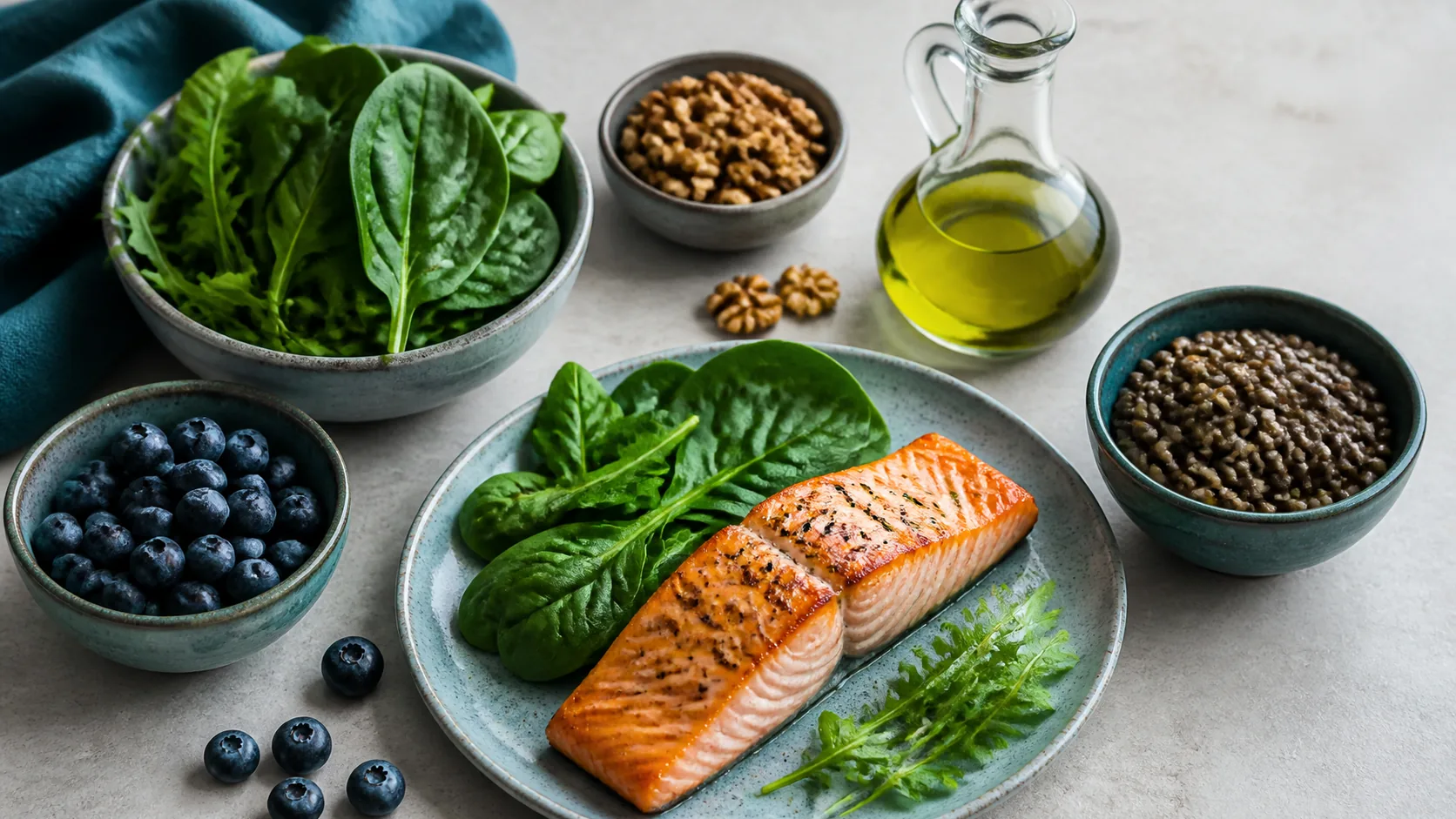
- Foods that protect the brain: fatty fish, leafy greens, berries, nuts, olive oil, legumes.
- Foods that harm it: ultra-processed products, excess sugar, trans fats and heavy drinking.
- The key nutrients for the brain: omega-3 (DHA), polyphenols, B vitamins, choline.
- Diet works together with sleep, movement and mental activity.
To eat for brain health, build your plate the way the MIND diet does: leafy greens and other vegetables every day, berries at least twice a week, nuts almost daily, fish at least once a week, legumes and whole grains regularly, olive oil as your main fat — and cut ultra-processed food, added sugar, trans fats and heavy drinking. The brain ages along with the rest of the body, but how fast it ages depends heavily on what you eat. Dementia cannot be prevented with any guarantee, yet lowering your risk and keeping your thinking clear for longer is realistic. This guide turns the evidence on brain nutrition into a practical system.
How diet affects the brain and dementia risk
The brain uses about 20% of the body’s total energy and is highly sensitive to the quality of your diet. Chronic inflammation, blood sugar spikes and a shortage of the right fats impair both neurons and the blood vessels that supply the brain. A diet rich in plants and good fats does the opposite: it supports the neurons themselves and the brain’s blood supply.
The best-known evidence concerns the MIND diet, a hybrid of the Mediterranean and DASH patterns. In observational studies, closer adherence to it was associated with a markedly lower risk of Alzheimer’s disease and with slower cognitive decline. That is not a guarantee, but it is one of the few modifiable factors you can actually act on, and it works best alongside the other changeable risks set out in Cognitive aging: the brain, memory, and dementia risk.
The MIND diet: what it is and what the evidence shows
MIND is not a strict diet. It is a list of foods to favor and foods to limit, each with a rough target frequency. That makes it a ready-made framework for eating for brain health.
| Eat more often | Target frequency | Limit |
|---|---|---|
| Leafy greens (lettuce, spinach) | Daily | Red meat |
| Other vegetables | Daily | Butter and margarine |
| Berries | 2+ times a week | Cheese in large amounts |
| Nuts | Almost daily | Pastries and sweets |
| Fish | 1+ time a week | Fried food and fast food |
| Legumes, whole grains | Regularly | Ultra-processed foods |
MIND overlaps heavily with the Mediterranean diet, but it puts the emphasis on the foods most studied for the brain: leafy greens and berries. That is convenient, because a single eating pattern then works for your heart and your brain at once.
Foods that protect the brain
A few food groups stand out for their demonstrated benefit to cognitive health. Make them the base of your diet. Leafy greens are the clearest example: they are one of the richest everyday sources of Folate (vitamin B9), the B vitamin the brain relies on for healthy homocysteine metabolism.
| Food | What it gives the brain | How to include it |
|---|---|---|
| Fatty fish | Omega-3 (DHA) for neuronal membranes | 1–2 times a week |
| Leafy greens | Folate (vitamin B9), lutein, vitamin K | Daily, in a salad or a side dish |
| Berries | Anthocyanins (polyphenols) | A handful at breakfast or as a snack |
| Nuts | Vitamin E, healthy fats | A small handful a day |
| Olive oil | Polyphenols, monounsaturated fats | Your main fat for dressing |
What harms the brain
Removing the harmful things often matters more than adding the healthy ones. Three groups of foods are particularly linked to faster cognitive aging.
Ultra-processed food and sugar. Glucose spikes and systemic inflammation damage the blood vessels of the brain, and diets high in ultra-processed food are associated in studies with faster cognitive decline.
Trans fats. Industrial trans fats (partially hydrogenated oils) are associated with worse memory and a higher risk of dementia.
Excess alcohol. Drinking heavily on a regular basis is toxic to neurons, and current data do not support any amount of alcohol as safe or beneficial for the brain.
Key nutrients for the brain
A handful of nutrients matter especially for the nervous system. Get them from food first, and consider supplements only in specific cases, such as a documented deficiency.
- Omega-3 (DHA) — a building block of neuronal membranes; the main food source is fatty fish, covered in our article on omega-3 and longevity.
- Polyphenols — from berries, leafy greens, olive oil and cocoa; they protect against oxidative stress.
- B vitamins (B12, B9, B6) — involved in homocysteine metabolism; a deficiency is associated with cognitive impairment.
- Choline — the precursor of acetylcholine, the neurotransmitter of memory; sources include eggs, legumes and fish.
The guiding principle for nutrients is the same as for brain nutrition in general: get them from whole foods rather than from isolated supplements. In food these compounds arrive alongside dozens of others, and on the current evidence it is that whole matrix that works better than any single nutrient in a capsule. A supplement makes sense in specific situations — B12 on a vegan diet, for example, or in older age, when absorption from food declines. Whether those B vitamins are doing their job shows up in one blood marker, Homocysteine — the marker 90% miss, which tends to rise when B12, B9 or B6 run short.
A weekly eating plan for brain health
To turn the principles into a habit, it helps to keep a simple weekly target in mind instead of counting every nutrient.
| Category | Weekly target | Example |
|---|---|---|
| Fish | 1–2 servings | Salmon, sardines, mackerel |
| Leafy greens | Daily | Spinach, arugula, lettuce |
| Berries | 3–4 servings | Blueberries, strawberries |
| Nuts | 5+ handfuls | Walnuts, almonds |
| Legumes | 3–4 servings | Lentils, chickpeas, beans |
| Olive oil | Daily | Salad dressing |
This set of targets automatically crowds out what harms the brain, and it needs nothing exotic: everything on the list is available in an ordinary supermarket.
Notice that the plan asks for nothing unusual or expensive. These are ordinary foods in slightly different proportions, and that is the strength of the approach: it is not about exotic superfoods but about being consistent with what is already within reach. Frozen berries in winter work as well as fresh ones, canned sardines are a full source of omega-3, and greens and legumes are in every store year round.
The gut–brain axis: why the microbiome matters
The brain and the gut are connected directly, through the vagus nerve, the immune system and the compounds that gut bacteria produce — the community collectively called the Gut microbiome. That is one reason the diet that suits your brain and the diet that suits your gut look so much alike.
A microbiome fed on fiber produces short-chain fatty acids, which lower inflammation, including inflammation in the brain. A diet low in fiber and high in ultra-processed food does the reverse: it impoverishes the microbiome and sustains chronic inflammation. Vegetables, legumes and fermented foods are therefore an investment in cognitive health, not only in digestion. The practical takeaway is simple: a variety of plant fiber is as good for your brain as it is for your gut.
When to expect results from eating for brain health
Eating for the brain is a strategy measured in years, not a course of treatment with a quick payoff. Knowing the time horizons helps you avoid quitting halfway.
Some effects show up within weeks: steady energy and concentration without the sugar swings, and a better general state when glucose stays level. The main value, though, is deferred. A lower risk of cognitive decline is measured in years and decades, which is exactly why studies score adherence to a diet over the long run rather than one-off changes. That changes the motivation: eating for brain health behaves like compound interest — the earlier you start and the longer you hold to it, the more the effect accumulates. Because the payoff is so gradual, it helps to have a starting point to measure against, and a short self-assessment such as Cognitive age: is your brain older than you? gives you a number you can re-check a year from now.
Myths about eating for the brain
An entire industry is built on the idea of “food for the mind”, and some of its promises do not survive scrutiny.
“Nootropic supplements make you smarter.” Most “brain supplements” have no convincing data in healthy people; your overall diet has a far bigger effect than any capsule.
“Coconut oil treats Alzheimer’s.” A popular myth with nothing behind it. It is also a source of saturated fat, which is not something to overdo.
“The brain needs sugar to concentrate.” The brain needs glucose, but it gets enough of it from complex carbohydrates; sweet “brain snacks” give you a spike and then a crash.
“Diet alone can restore memory.” Diet lowers risk and supports function, but it does not reverse dementia once it has developed. It is a tool for prevention, not treatment, and it works alongside the other factors.
How to start eating for brain health
To avoid putting this off until Monday, pick one or two actions from the list below and put them in place this week. That is enough to start.
- Add fish — plan 1–2 fish meals for the week (canned sardines count).
- Greens every day — a handful of lettuce or spinach with any meal.
- Berries instead of sweets — keep frozen berries on hand as a dessert replacement.
- Drop one ultra-processed product — a sweet snack or a soda, for example.
Once those habits stick, add the next ones. Going gradually is more reliable than the “perfect diet starting tomorrow”, which rarely survives a week.
Lifestyle alongside diet
Eating for the brain does not work in a vacuum. Three factors amplify its effect, and without them a diet never shows its full value: good sleep (during sleep the brain clears out metabolic waste), regular physical activity (which improves blood flow to the brain and stimulates neurogenesis), and mental effort — learning something new, which builds cognitive reserve. Diet, sleep, movement and mental activity together do more than any of them alone.
Social connection deserves a separate mention. In studies, isolation and loneliness are associated with faster cognitive decline, and an active social life with slower decline. Shared meals combine two benefits at once: the quality of the food and the human contact. So it is worth reading “eating for brain health” as something wider than the plate — a way of living in which food, movement, sleep, learning and company support one another.
Common mistakes
- Betting on a “brain pill” instead of a systematic diet — nootropic supplements do not replace what you eat.
- Going fat-free — the brain needs good fats, and cutting them out entirely does harm.
- Juices and “healthy” bars with a high sugar content.
- Ignoring sleep and movement — without them, diet works at half strength.
Can diet prevent dementia?
Not with any guarantee. But diet is one of the proven modifiable risk factors: the MIND and Mediterranean patterns are associated with lower risk and slower cognitive decline.
Do you need supplements for the brain?
Food comes first. Supplements such as omega-3 or B12 are justified when there is a deficiency. Nootropic blends with unproven benefits do not replace a good diet.
Is it true that the brain needs sugar?
The brain needs glucose, but it gets plenty of it from complex carbohydrates. Added sugar and glucose spikes do the opposite: they damage the blood vessels of the brain.
Do berries and cocoa help?
Yes, because of their polyphenols (anthocyanins, flavanols). They are not a cure-all, but they are a useful and enjoyable part of a diet built for the brain.
Where should you start?
Add fish 1–2 times a week, leafy greens every day and berries several times a week, while cutting back on ultra-processed food. That is the core of eating for brain health.
Sources (4)
Disclaimer. This article is for information only and does not replace medical advice. Talk to a qualified clinician before changing anything about your health.