How to Build a Longevity Diet: A Practical Guide
By Longevity Lab · Published: July 21, 2026
Based on peer-reviewed research — full source list at the end of this article. This is educational information, not medical advice.
- What you eat moves lifespan more than any single supplement or workout.
- A longevity diet is built on plants, whole foods, good-quality protein and as little ultra-processed food as possible.
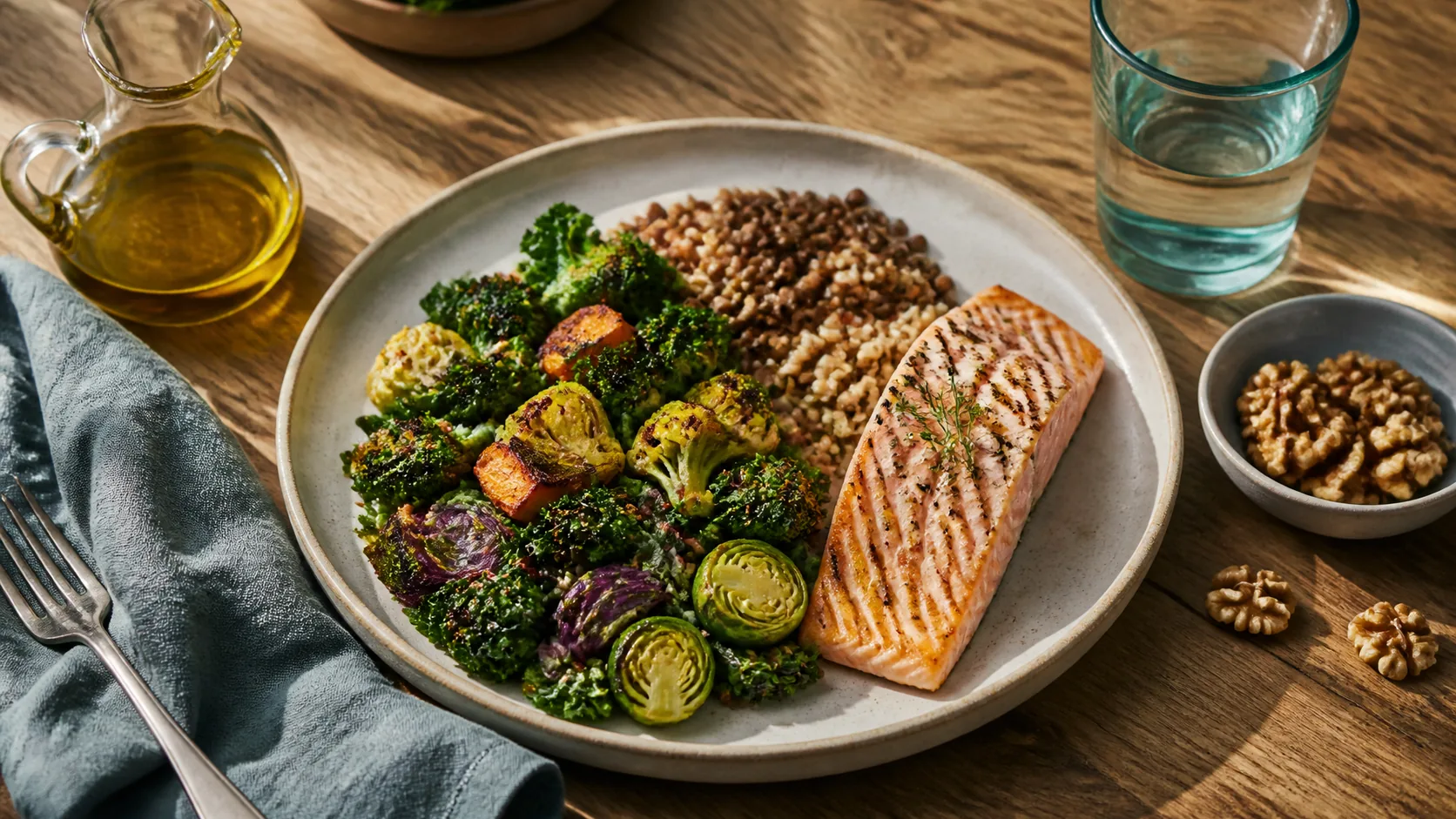
- The longevity plate: half vegetables and greens, a quarter protein, a quarter whole-food carbohydrates.
- After 40, spread protein evenly through the day: 25–35 g per meal, 1.2–1.6 g per kg of body weight daily.
- Make the switch over 4 weeks, one change at a time, instead of all at once.
To build a longevity diet, put plants at the center of the plate: half vegetables and greens, a quarter protein, a quarter whole-food carbohydrates, with olive oil, nuts and fatty fish as the fat, and as little ultra-processed food as you can manage. Add 1.2–1.6 g of protein per kg of body weight a day, spread across 3–4 meals, and you have covered most of what the evidence supports. Diet is the most powerful and the most controllable lever you have: no supplement and no training program changes the risk of age-related disease as much as what you eat every day. This guide is not another diet. It is a practical system for turning the science into a way of eating you can keep up for years.
Why diet is the biggest lever for longevity
Large nutrition studies show that diet quality tracks directly with lifespan. In the PREDIMED trial, a Mediterranean diet reduced the risk of cardiovascular events by about 30% compared with a standard diet. Modeling work estimates that switching from a typical Western diet to a whole-food diet, even in middle age, can add several years of life.
The reason is that food acts on every key mechanism of aging at once: inflammation, glucose and insulin levels, the state of your blood vessels, and the Gut microbiome. That is also why chasing one magic food fails, because what matters is the structure of the whole diet. The good news is that the universal principles behind every longevity diet, from the Mediterranean pattern to the way people eat in the Blue Zones, are almost identical.
Diet also works cumulatively. A handful of good days settles nothing; the effect comes from eating whole foods steadily, year after year. So the real test of a longevity diet is not how strict it is, but whether you can stay on it for decades without forcing yourself. That is what separates an evidence-based approach from fashionable diets that deliver fast results and get abandoned just as fast.
Five principles of a longevity diet
Every longevity diet rests on five pillars. Here is what each one asks of you, plus a table to check at a glance.
A plant-based foundation
Vegetables, greens, legumes, nuts, whole grains and fruit should make up most of the plate. They deliver fiber, polyphenols and micronutrients at a low calorie density. This does not mean you have to go vegan. It is a question of proportion: plants at the center of the plate, animal foods as the supporting act.
Good-quality protein
Protein protects muscle, but the source and the spacing matter more than the raw total. Fish, legumes, eggs, poultry and fermented dairy beat processed meat. For the age-related details, see the guide to protein after 40.
Healthy fats
Where the fat comes from decides more than how much of it there is. Olive oil, nuts, avocado and fatty fish work for your blood vessels; trans fats and an excess of saturated fat work against them. Omega-3s from fish are a priority of their own.
Whole foods instead of processed ones
The less a food has been processed, the better. Ultra-processed food, meaning snacks, sausages, sugary drinks and pastries, is consistently associated with higher mortality in studies, and it crowds the useful food out of your diet.
Sugar and glucose control
Glucose spikes speed up protein glycation, one of the mechanisms of aging. Whole-food carbohydrates with their fiber intact, in place of refined ones, flatten those spikes. If you want to know where you already stand, fasting glucose, HbA1c, weight and waist together score your Risk of developing diabetes long before a diagnosis appears.
| Principle | Add | Cut back |
|---|---|---|
| Plant-based foundation | Vegetables, legumes, nuts, greens | The share of animal foods |
| Good-quality protein | Fish, legumes, eggs, poultry | Processed meat |
| Healthy fats | Olive oil, avocado, fish | Trans fats, deep-fried food |
| Whole foods | Grains, whole-grain bread | Snacks, sugary drinks |
| Sugar control | Fiber, complex carbohydrates | Sugar, white flour |
The longevity plate: proportions and portions
The easiest way to run your diet is not by counting calories but by composing the plate. The plate method sets the proportions automatically, with no weighing.
| Part of the plate | Share | What goes there |
|---|---|---|
| Vegetables and greens | 1/2 | Colorful vegetables, salad, greens |
| Protein | 1/4 | Fish, legumes, eggs, poultry |
| Whole-food carbohydrates | 1/4 | Grains, legumes, whole-grain bread, sweet potato |
| Fats | an add-on | A spoon of olive oil, a handful of nuts |
This works for any meal and does not require giving up the food you like, because the proportions change rather than the meal itself. Over time the plate shifts toward plants without ever feeling like a restriction. A simple way to follow that shift is the Waist-to-height ratio (WtHR), which tracks central fat rather than weight alone.
How much protein, and when to eat it
Muscle is lost faster with age (Sarcopenia), and the body’s ability to use protein declines. After 40, then, both the daily total and its even distribution through the day matter.
| Parameter | Target | Notes |
|---|---|---|
| Daily intake | 1.2–1.6 g per kg of body weight | Higher if you train hard |
| Per meal | 25–35 g | The threshold that triggers muscle synthesis |
| Number of meals | 3–4 containing protein | Spread out, not all at dinner |
| Source priority | Fish, legumes, eggs | Variety beats any single source |
In practice: if the whole day’s protein arrives in the evening, muscle misses the stimulus. Adding a protein component to breakfast and lunch is one of the most underrated habits for holding on to strength as you age. Whether it is working shows up in muscle mass rather than on the scale, which is what a Body composition assessment measures through indices such as FFMI and SMI.
Meal timing: your eating window and the order of food
When you eat matters too, not only what. Many people in the Blue Zones eat within a limited daytime window and do not snack at night. Moderate intermittent fasting, such as a 10–12 hour eating window, is a workable and undemanding tool for a lot of people.
The order of food helps as well. Start the meal with vegetables and protein and leave the carbohydrates for the end, and the glucose spike after eating is smaller. It is a simple move that changes nothing about what is on the plate.
What to drink on a longevity diet
Drinks are the underrated part of the diet: they are an easy way to take on sugar without noticing, or a way to support your health. The basic choices are simple.
- Water — your main drink; thirst is a more reliable guide than rigid liters-per-day rules.
- Tea and coffee — sources of polyphenols; coffee in moderate amounts is associated with lower mortality.
- Sugary drinks — the main hidden source of sugar; cutting them back pays off fast.
- Alcohol — current data do not support a safe beneficial dose; less is better.
Swapping one sugary drink a day for water or unsweetened tea is one of the simplest changes with a noticeable effect on blood glucose and weight.
Water deserves less anxiety than it gets. Hard rules such as eight glasses a day have no solid basis. The body regulates the need well through thirst, and some of your fluid comes from food and other drinks. The practical marker is simple: pale urine and no thirst. Deliberately pouring extra liters into yourself is not necessary.
Common mistakes when switching to a longevity diet
Most people fall off not because of the wrong foods but because of the wrong transition strategy. These are the usual traps.
- Switching everything overnight — your body and your habits cannot keep up, and a relapse is close to inevitable.
- Low-fat products in place of fat — they often have sugar added, and there is no need to cut healthy fats.
- Juices and smoothies in place of whole fruit — the fiber is gone and the fast sugar stays.
- Betting on supplements instead of food — supplements do not make up for a poor diet.
- Falling short on protein — it is easy to undereat protein when you lean into plants, so keep an eye on the target.
A four-week transition plan
The change sticks best when you make it gradually, one focus per week. By the end of the month the new habits are set without any of it feeling like a diet.
| Week | Focus | What to do |
|---|---|---|
| 1 | Vegetables | Add vegetables to every main meal (half the plate) |
| 2 | Protein | Put a protein component in breakfast and lunch, not only dinner |
| 3 | Processing | Replace sugary drinks and snacks with water, nuts and fruit |
| 4 | Timing | Set a daytime eating window and a food order (vegetables → protein → carbohydrates) |
After four weeks the diet is rebuilt along its main axes. What is left is fine-tuning for your own tastes and tolerance: a longevity diet should be what you enjoy eating for years, not a temporary diet. Do not aim for perfect. The 80/20 rule, where the base of the diet is healthy and 20% is left for pleasure without guilt, works better over the long run than strict bans that break sooner or later.
Myths about eating for longevity
A lot of myths have piled up around nutrition, and they get in the way of building a diet that works. Here are the most persistent ones.
“There are superfoods that extend life.” No single food settles anything; the structure of the whole diet is what works. Berries and greens are good for you, but they do not cancel out the overall quality of your eating.
“Carbohydrates are the enemy.” Refined carbohydrates and sugar are the problem, not whole grains and legumes. In the Blue Zones the share of complex carbohydrates is high, and it does not stand in the way of longevity.
“The less fat, the better.” Healthy fats from olive oil, nuts and fish are what your blood vessels and brain need, and low-fat products often make up for the lost taste with added sugar.
“Supplements can replace real food.” No formula reproduces the matrix of whole food: the fiber, the polyphenols and the way they interact. Supplements only close specific gaps.
Do you have to give up meat?
No. It is a question of proportion and quality: plants as the base, and meat preferably unprocessed and in moderate amounts. Giving it up completely is not required.
Do you need to count calories?
For most people the plate method and whole foods are enough, because they self-regulate calorie intake. Calorie counting is a tool for specific goals, not a requirement.
Is this diet suitable if you have diabetes or another condition?
The basic principles are universal, but with a chronic condition or ongoing medication you should agree the diet with your doctor or a dietitian.
What matters more, what you eat or when you eat?
The composition of the diet matters more than the timing. Meal timing, the eating window and the order of food are a useful layer on top, but they do not make up for a poor diet.
Where do you start if changing everything at once is too much?
Start with week one of the plan and simply add vegetables to every meal. That is the easiest change with the biggest payoff.
Sources (4)
Disclaimer. This article is for information only and does not replace medical advice. Talk to a qualified clinician before changing anything about your health.