How to Improve Sleep: A Practical Sleep Hygiene Protocol
By Longevity Lab · Published: July 21, 2026
Based on peer-reviewed research — full source list at the end of this article. This is educational information, not medical advice.
- A regular 7–9 hours of sleep is associated with the lowest mortality; both chronic short sleep and chronic long sleep are associated with higher mortality.
- During sleep the brain clears metabolic waste through the glymphatic system, which is one of the few evidence-backed ways to lower dementia risk.
- The strongest levers are a fixed sleep schedule, darkness, a cool room, and no caffeine or alcohol in the evening.
- For insomnia, behavioral treatment (CBT-I) is the first-line choice, not sleeping pills.
- Two weeks of running the protocol consistently is realistically enough to reset your sleep.
To improve sleep, fix your wake time, get daylight soon after waking, keep the bedroom dark and at 18–20 °C (64–68 °F), stop caffeine by early afternoon, and drop evening alcohol. Most adults need 7–9 hours, and two weeks of running that protocol consistently is usually enough to feel the difference. Sleep is the one longevity intervention that costs nothing and runs itself, provided you stop getting in its way. Chronic short sleep does the opposite: it hits every system in the body at once. This guide is the practical version, a set of habits that add up to sleep that restores you instead of wearing you down.
Why sleep is the foundation of longevity
The link between sleep and lifespan is U-shaped: both short sleep (under 6 hours) and long sleep are associated with higher mortality, and risk is lowest at 7–9 hours. Short sleep raises blood pressure, glucose, appetite and systemic inflammation, which means it directly accelerates the stress-related mechanisms of aging. To see where your own nights sit in that picture, the Stress-aging index calculator weighs sleep quality together with stress, activity and diet.
A separate mechanism is the glymphatic system: during deep sleep the brain actively flushes out metabolic waste, including beta-amyloid, whose accumulation is linked to Alzheimer’s disease — the glossary entry Amyloid (beta-amyloid) explains what that protein is. That is why good sleep is treated as one of the few proven ways to reduce dementia risk, and it belongs alongside the other modifiable factors covered in Cognitive aging: the brain, memory, and dementia risk. For the underlying biology, see our article on how sleep affects aging.
How much sleep you need and how to know it is enough
The reference range for adults is 7–9 hours, though individual need varies slightly. Judge it by the signs of sufficient sleep rather than by the number alone.
- You wake up at roughly the same time, mostly without an alarm.
- You get through the first half of the day without heavy sleepiness or energy crashes.
- You do not need to sleep 2+ hours longer on weekends to catch up.
- Your mood and concentration hold steady through the day.
Need shifts a little with age and workload: teenagers need more, and in older adults sleep architecture changes and becomes lighter, but 7–9 hours stays the reference for adults. Chasing a record-short night is not a sign of efficiency. More often it is hidden sleep debt with consequences that accumulate.
If you undersleep badly on weekdays and then sleep far longer on weekends, that is social jet lag, and it does harm. A steady schedule matters more than your weekly total of hours.
Short sleepers deserve a separate note, meaning the people who supposedly do fine on 4–5 hours. A genuine genetic ability to feel rested on that little is extremely rare, a fraction of a percent of people. Far more often someone has simply adapted to chronic sleep debt and stopped noticing the drop in performance, even though it is objectively there. So aim at the 7–9 hour range rather than at the conviction that you personally need less.
Sleep hygiene: an eight-habit protocol
Sleep hygiene is the set of conditions under which sleep arrives and deepens on its own. The protocol below is sorted by strength of effect.
| Habit | How to do it | Why it works |
|---|---|---|
| Fixed schedule | Go to bed and get up at the same time, weekends included | Stabilizes the circadian rhythm |
| Morning light | 10–20 minutes of daylight in the morning | Sets the body clock for the day |
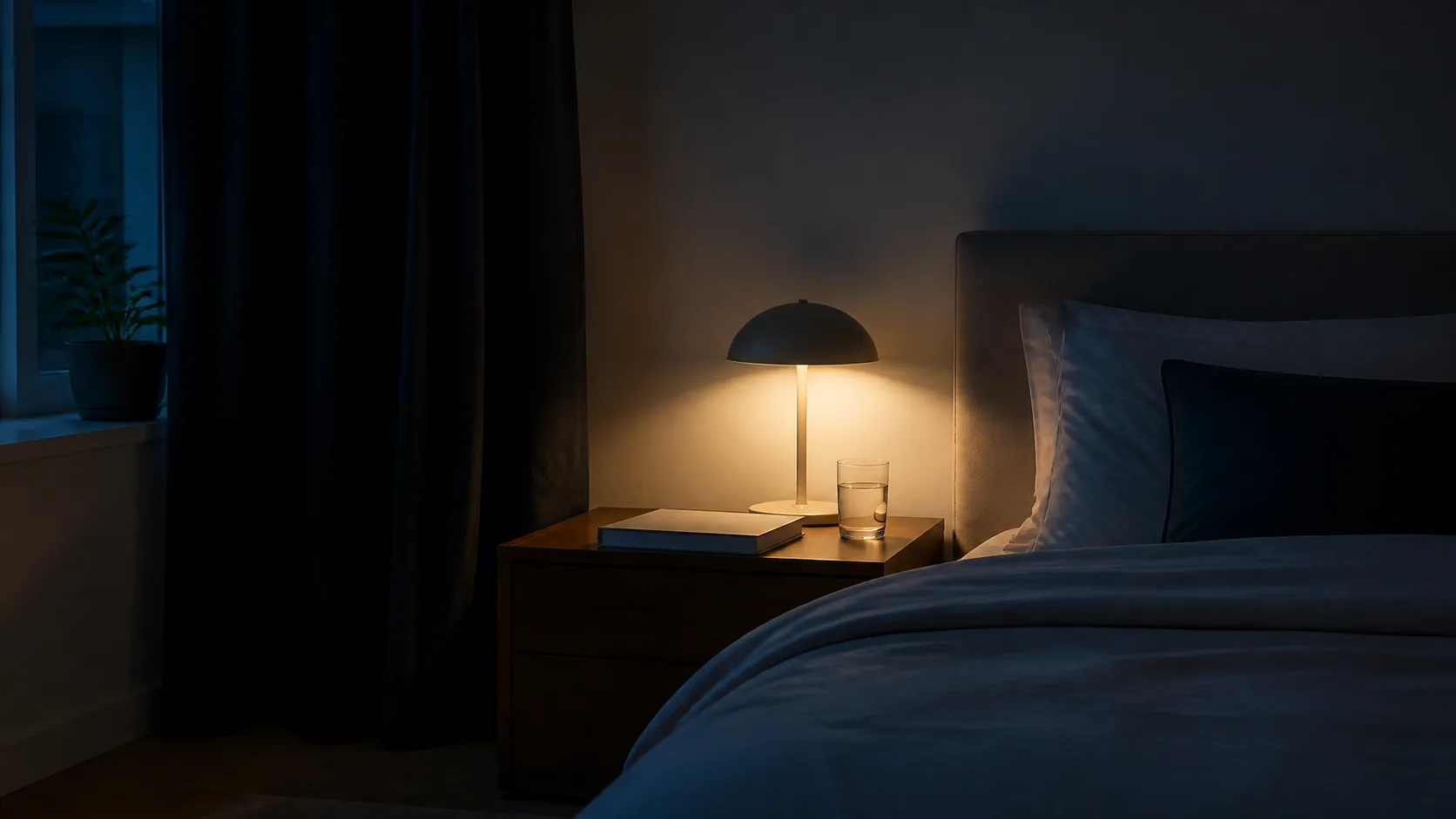
| Dark bedroom | Blackout curtains, remove LED indicators | Melatonin is produced in darkness |
| Cool room | 18–20 °C (64–68 °F) in the bedroom | A falling body temperature triggers sleep |
| Caffeine before 2 p.m. | Last cup no later than midday | Half-life of 5–6 hours |
| No alcohol in the evening | Do not use it as a sleep aid | It breaks up the deep stages of sleep |
| Screens off an hour before bed | Dim the lights, put the phone away | Blue light suppresses melatonin |
| Wind-down ritual | Reading, a shower, breathing | Signals the body to shift toward sleep |
You do not have to install all eight habits at once, and trying to is a common reason people conclude that sleep hygiene does not work. Start with the top two rows of the table, a fixed schedule and morning light, because they carry the strongest effect, and add the rest one at a time. A warm shower before bed works surprisingly well: the body cools once you step out, and it is that drop in temperature that triggers sleepiness.
Light, caffeine and alcohol: what to control by timing
Three factors decide sleep quality more than anything else, and all three come down to timing.
Light. Bright light in the morning and dim light in the evening is the main dial for the circadian rhythm, the 24-hour internal clock described in Circadian rhythm — the biological clock. A morning walk works better than any melatonin supplement.
Caffeine. It blocks receptors for adenosine, the molecule that builds sleep pressure. Even if you fall asleep after an evening coffee, sleep architecture gets worse. For how that works, see our piece on coffee and longevity.
Alcohol. It speeds up falling asleep but suppresses deep and REM sleep in the second half of the night, so sleep turns shallow. As a regular sleep aid, alcohol is the wrong tool.
What to do about insomnia
When sleep problems become regular, the proven first choice is not a pill but cognitive behavioral therapy for insomnia (CBT-I). Several of its principles you can apply on your own.
- Do not lie there awake. If you have not fallen asleep in about 20 minutes, get up, do something quiet in dim light, and go back to bed when you feel sleepy.
- Keep the bed for sleep. Do not work or scroll a feed in bed, so the bed-equals-sleep association can rebuild.
- Fix your wake time. Get up at the same time regardless of how you slept, which strengthens the rhythm.
- Limit time in bed. Counterintuitively, cutting time in bed down to the sleep you actually get makes that sleep deeper.
If insomnia lasts more than a month, or if there is loud snoring with pauses in breathing, see a doctor: this may be sleep apnea, which raises risk on its own.
Sleep anxiety deserves separate attention, and the general pattern behind it is covered in Anxiety. After one bad night people often start dreading the next one, and that expectation is exactly what keeps them awake, closing the loop. Breaking it starts with a change of framing: one sleepless night is not dangerous, the body compensates for it, and the calmer you are about it, the faster sleep normalizes. Trying to force yourself to sleep by willpower works against you, because sleep comes on the back of relaxation, not control. When that worry runs well past bedtime, the Stress Level Test (PSS-10) is a quick way to see how much perceived stress you are carrying into the night.
Sleep trackers: what they are actually good for
Smart watches and rings estimate sleep stages only approximately and do not replace diagnostic testing. But they do one job well: they show your regularity and the overall trend. Use a tracker as a mirror for your habits, what time you went to bed and how long you slept, not as a precise medical instrument, and do not chase perfect deep-sleep numbers, because anxiety about the readings itself gets in the way of sleeping.
Sleep with shift work and air travel
A broken schedule is its own challenge, because it runs against the circadian rhythm. You cannot remove the harm of shift work entirely, but you can soften it.
- On night shifts, darken the bedroom as much as possible during the day (blackout curtains, a sleep mask) and keep the light bright at work.
- After a shift, wear dark glasses on the way home so morning light does not wake the brain up for good.
- For flights, shift your schedule in advance by 1 hour a day toward the new time zone, and catch morning light once you arrive.
- Melatonin belongs exactly here: it helps reset the rhythm with jet lag and shift changes.
The core idea is the same throughout: manage light. Light is the main signal for the internal clock, and handling it well matters more than any sleeping pill.
Be realistic about the limits. Lifestyle cannot fully neutralize the harm of years of night work, and researchers say so plainly. But the measures above do reduce the severity of the consequences, and they make a noticeable difference to how you feel and function between shifts.
Common mistakes
- Catching up on weekends deepens social jet lag instead of solving the problem.
- Training late in the evening: an intense session right before bed can make it harder to fall asleep.
- Melatonin as a sleeping pill: it is a rhythm regulator, not an off switch. It helps with jet lag but does not replace sleep hygiene.
- Long daytime naps: a nap longer than 20–30 minutes lowers sleep pressure by night.
A two-week plan to reset your sleep
| Period | Focus | Action |
|---|---|---|
| Days 1–3 | Anchor | Fix your wake time, get outside into the light in the morning |
| Days 4–7 | Evening | Cut caffeine after midday and screens an hour before bed |
| Days 8–11 | Environment | Set up the bedroom: darkness, 18–20 °C (64–68 °F), quiet |
| Days 12–14 | Ritual | Add a stable wind-down ritual before bed |
By the end of two weeks most people fall asleep faster and lose the morning grogginess. If sleep does not improve after you have run the protocol consistently, that is a signal to discuss it with a doctor.
If the whole protocol feels like too much at once, start today with a single action: set an alarm for the same wake time every day and get 10–15 minutes of daylight in the morning. That is the strongest step you can take, and it requires changing nothing about your evening. Everything else is easier to add once the wake-time anchor holds.
Do not expect a result on the first night. The circadian rhythm takes several days to shift, and it is consistency in your wake time and light exposure that produces the cumulative effect. One or two bad days inside the protocol are normal, not a reason to quit.
How many hours of sleep do you actually need?
Most adults need 7–9 hours. Judge it by how you feel: no daytime sleepiness and steady energy matter more than a specific number.
Can you catch up on lost sleep?
Partly, and only briefly. Chronic sleep debt is not repaid by sleeping in on weekends. The swings in schedule do harm of their own. Sleeping the same amount every day works better.
Does melatonin help?
Melatonin is useful for time-zone changes and a disrupted rhythm, but it is not a sleeping pill. For ordinary insomnia, start by fixing sleep hygiene and your schedule.
Does evening exercise hurt sleep?
Light activity does not, but an intense workout right before bed can make it harder to fall asleep. Plan training no later than 2–3 hours before sleep.
When should you see a doctor?
If insomnia lasts more than a month, if there is loud snoring with pauses in breathing, or if daytime sleepiness is severe, get it checked. It may be sleep apnea.
Sources (4)
Disclaimer. This article is for information only and does not replace medical advice. Talk to a qualified clinician before changing anything about your health.