What People Eat in the Blue Zones and What Works
By Longevity Lab · Published: July 21, 2026
Based on peer-reviewed research — full source list at the end of this article. This is educational information, not medical advice.
- The Blue Zones are regions where, by the available records, an unusual number of people reach very old age; their diets get studied as a reference point.
- The common denominator is a mostly plant-based diet: legumes, vegetables, whole grains and nuts, with meat eaten rarely and in small amounts.
- The strongest evidence belongs not to the “Blue Zones diet” as a brand but to the eating patterns closest to it: the Mediterranean diet and legume-heavy diets.
- No single superfood does the work. The whole pattern of eating and living does.
- The age records behind the longevity claims have been questioned, so treat the idea as a useful guide rather than gospel.
What the Blue Zones are
People in the Blue Zones eat a mostly plant-based diet: legumes such as beans, lentils and soy, plus vegetables, whole grains and nuts, with meat eaten rarely and in small portions. The parts of that pattern with the strongest scientific support are the legumes and the wider plant-forward structure of the Mediterranean diet, not any single “Blue Zones superfood”. “Blue Zones” is the label journalist Dan Buettner popularized for a handful of regions where unusually many people are said to live into deep old age: Okinawa in Japan, Sardinia in Italy, Ikaria in Greece, Nicoya in Costa Rica, and the Adventist community in California. It is a memorable idea and it gets quoted endlessly, but one caveat belongs up front: this is not a strict scientific term. It is a journalistic frame, and in recent years the quality of the age records behind it has come under serious question. The regions themselves, and the shared habits usually credited for that longevity, are covered separately in Blue Zones and the Lessons of a Long Life.
So the useful move is to look past the brand and ask what nutrition research actually supports about eating for Longevity. The same skepticism is worth applying to the meal-timing rules that often travel alongside this way of eating, which Intermittent Fasting and Aging, Minus the Hype examines on its own.
What their diets have in common
The regional cuisines differ a lot, but they converge on the same few things:
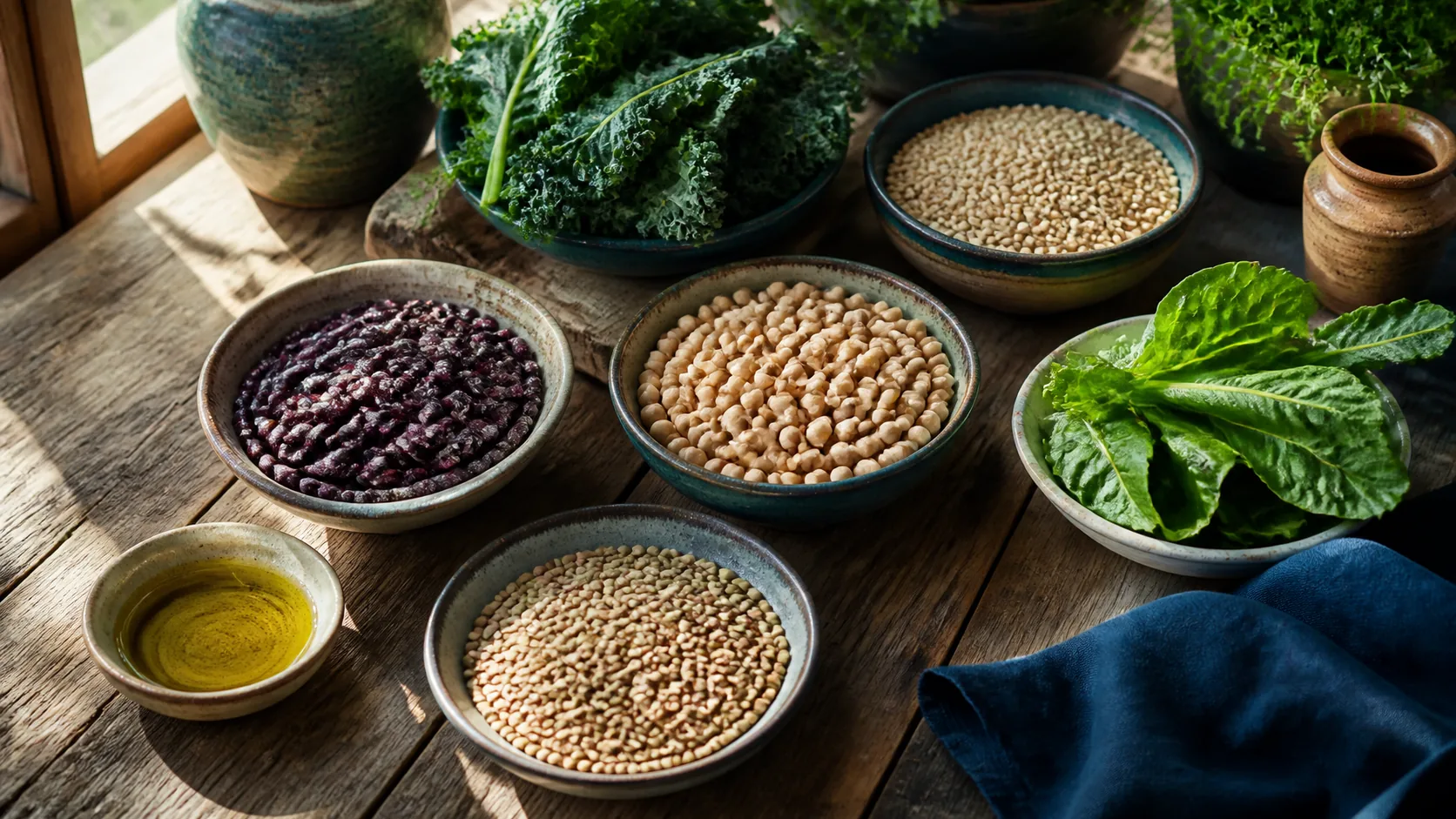
- Plants are the base. Legumes (beans, lentils, soy), vegetables, whole grains, nuts and leafy greens.
- Meat is occasional. More a seasoning than the center of the plate, with fish in moderate amounts.
- Very little ultra-processed food and very little added sugar.
- Moderation. Okinawa has the principle of hara hachi bu: eat until you are about 80% full.
What actually holds up in the evidence
Individual parts of this pattern have a solid evidence base, and the measures they move — waist, blood pressure, glucose and blood lipids — are the same ones behind Metabolic syndrome — the hidden pandemic of the 21st century:
- Legumes. In a cross-cultural study of older people, legume intake was one of the most consistent dietary predictors of survival.
- A Mediterranean-style diet. In a large randomized controlled trial (RCT), it reduced the risk of cardiovascular events.
- Plant-based diets in general are associated with lower all-cause mortality and a lower risk of chronic disease.
The key point: no magic food does the work. The whole diet and the whole lifestyle do, including movement, sleep and social ties. Hunting for the one “Blue Zones superfood” misses the target.
How to apply it yourself
- Make legumes a regular part of your diet, several times a week.
- Fill half your plate with vegetables, and choose whole grains instead of refined ones.
- Move meat from the center of the plate to the edge, and add fish.
- Cut back on ultra-processed food and sugary drinks.
- Do not overeat. Stop before you feel completely full.
Frequently asked questions
Do you have to give up meat completely?
No. People in the Blue Zones do eat meat, just rarely and in small amounts. The bigger shift is the move toward plant foods.
Do people in the Blue Zones really live longer than everyone else?
The data on how many people there reach extreme old age is disputed in places and has been criticized for accuracy. But their eating principles line up with what other research already shows to be healthy.
Is there one key longevity food?
There is no single food. The whole pattern is what works: a plant-based base, moderation, and very little processed food.
Sources
Sources (4)
- Darmadi-Blackberry I, et al. Legumes: the most important dietary predictor of survival in older people. Asia Pac J Clin Nutr. 2004;13(2):217–220. PubMed →
- Estruch R, et al. Primary prevention of CVD with a Mediterranean diet (PREDIMED). NEJM. 2018;378:e34. PubMed →
- Willcox DC, et al. The Okinawan diet: health implications. J Am Coll Nutr. 2009;28 Suppl:500S–516S. PubMed →
- Wang X, et al. Fruit and vegetable consumption and mortality: meta-analysis. BMJ. 2014;349:g4490. PubMed →
Disclaimer. This article is for information only and does not replace medical advice. Talk to a qualified clinician before changing anything about your health.