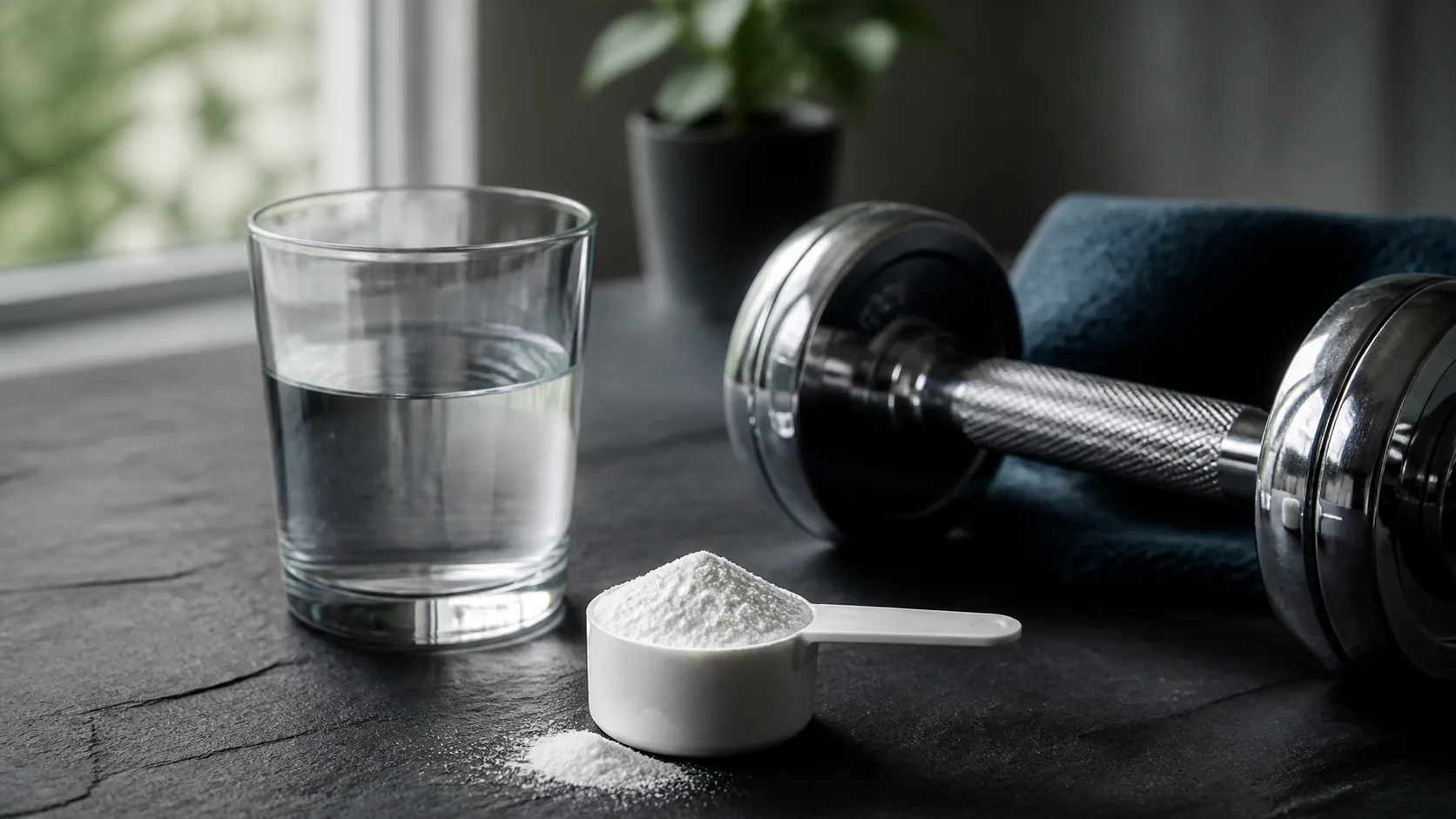
Creatine for Muscle, Brain, and Healthy Aging
By Longevity Lab · Published: July 21, 2026
Based on peer-reviewed research — full source list at the end of this article. This is educational information, not medical advice.
- Creatine is one of the most studied and safest sports supplements available.
- Combined with strength training, it increases strength and muscle mass more than training alone.
- In older adults, creatine plus training helps preserve muscle, which makes it an ally against sarcopenia.
- There is evidence of a possible benefit for memory and cognition, especially in older adults and during sleep deprivation.
- The standard dose is about 3–5 g a day, and the myth that creatine harms healthy kidneys is not supported.
Creatine monohydrate, taken at about 3–5 g a day alongside strength training, increases strength and Lean muscle mass more than training on its own, and it does so in younger and older adults alike. Meta-analyses also point to a moderate benefit for memory and cognitive performance, most clearly in older people and under energy stress such as sleep loss. Creatine still carries a reputation as a supplement for bodybuilders, but the science has moved well beyond the gym, toward the brain and healthy aging, and it remains one of the few supplements with a genuinely solid evidence base. Here is what creatine does, who benefits most, how to take it, and why the kidney fears are overstated.
What creatine is
Creatine is a compound your body makes on its own and also takes in from meat and fish. Muscle stores it as phosphocreatine, a fast-release energy buffer for short, intense efforts such as a sprint or a heavy lift. Supplementing raises how much is stored in muscle, which lets you do slightly more work in a session and, over weeks, produces a larger training effect.
Muscle and strength
This is the best-established effect. Combined with strength training, creatine increases strength and muscle mass more than training without it. That matters more with age: in older adults, creatine plus resistance training supports muscle and physical function better than training alone, which makes it an ally against Sarcopenia. One caveat is important. Without training, the effect is modest. The supplement amplifies the training stimulus, it does not replace it. If you want a baseline to train against, a Body composition assessment shows your fat-free mass and muscle indices, the numbers a creatine-plus-training block is meant to move.
Brain and cognition
A newer and more interesting line of research looks at the brain, which also runs on energy. Meta-analyses point to a possible moderate improvement in memory and cognitive test scores, particularly in older adults and in states of energy stress, for example after poor sleep or during heavy mental workload. The evidence here is not as firm as it is for muscle, but the direction is promising and the field is active. If you want a personal starting point before judging any effect on yourself, a short screen such as Cognitive age: is your brain older than you? gives a rough read on memory and thinking speed.
How to take it, and safety
The practical guidance is simple:
- form — creatine monohydrate, the most studied and the cheapest; exotic forms are not worth the markup;
- dose — about 3–5 g a day, taken consistently; a loading phase speeds up saturation but is not required;
- timing is not critical, and long-term use is fine;
- safety — creatine is well tolerated in healthy people, and the myth that it harms healthy kidneys is not supported.
If you have CKD (chronic kidney disease), are pregnant, or take prescription medication, discuss creatine with a doctor first. For healthy people it is safe at the doses that have been studied.
Who benefits most
Creatine is not only for athletes. It can be especially valuable for older adults (muscle, and possibly the brain), for people with a low meat intake, who start with lower muscle creatine stores, and for anyone who lifts. Treat it as an addition to adequate protein and regular training, not a substitute for either. Older readers can gauge where they are starting from with Fitness age: the age of your physical fitness, which scores strength, endurance and body composition together.
Frequently asked questions
Does creatine damage your kidneys?
In healthy people, no. The research does not support it. Caution is warranted if you have kidney disease, and in that case the decision belongs to your doctor.
Do you need a loading phase?
No. Taking 3–5 g a day saturates muscle within a few weeks without high starter doses. Loading only speeds the process up.
Does creatine make you retain water?
A small amount of water is held inside the muscle cell. That is part of how creatine works rather than swelling, and it has no negative effect on health.
Is creatine only for athletes?
No. Older adults, people who eat little meat, and anyone who trains with weights may benefit most, for muscle and possibly for the brain.
Sources
Sources (3)
- Chilibeck PD, et al. Creatine and resistance training on lean tissue in older adults (meta-analysis). Open Access J Sports Med. 2017;8:213–226. PubMed →
- Avgerinos KI, et al. Effects of creatine supplementation on cognitive function (meta-analysis). Exp Gerontol. 2018;108:166–173. PubMed →
- Kreider RB, et al. ISSN position stand: safety and efficacy of creatine. J Int Soc Sports Nutr. 2017;14:18. PubMed →
Disclaimer. This article is for information only and does not replace medical advice. Talk to a qualified clinician before changing anything about your health.