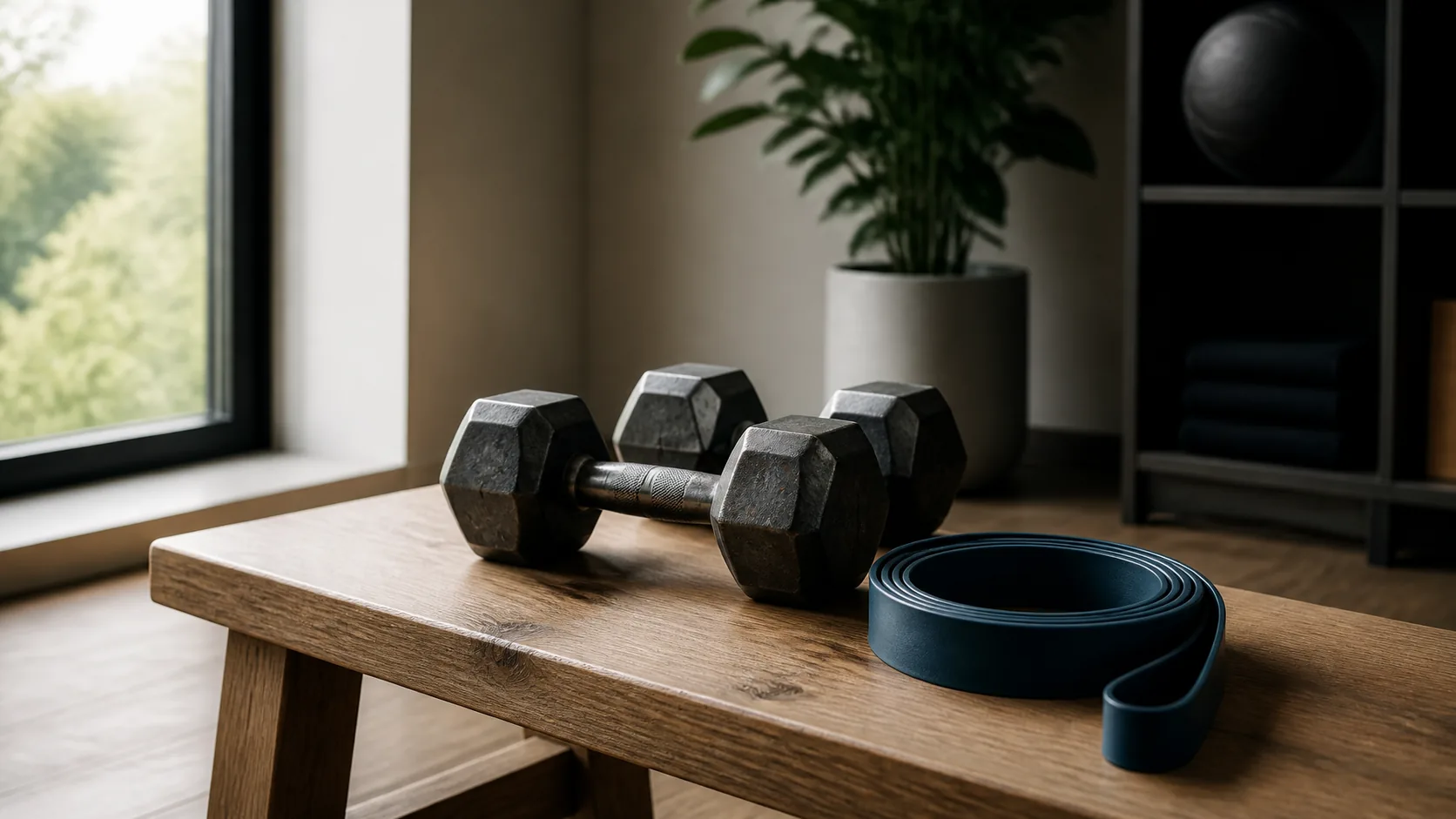
Strength Training Against Sarcopenia
By Longevity Lab · Published: July 21, 2026
Based on peer-reviewed research — full source list at the end of this article. This is educational information, not medical advice.
- Sarcopenia is the age-related loss of muscle mass and strength, and it accelerates after ages 50–60.
- Strength training is the main proven way to slow it down and to reverse part of it.
- In meta-analyses, regular muscle-strengthening activity is associated with lower all-cause mortality.
- Muscle is not only strength: it also drives metabolism, resistance to falls, and independence in later life.
- Starting works at any age; the keys are progressive loading and enough protein.
Strength training is the most effective proven way to slow and partly reverse sarcopenia, the age-related loss of muscle mass and strength that accelerates after ages 50–60. Two or three resistance sessions a week, paired with roughly 1.2–1.6 g of protein per kg of body weight a day, build muscle back at any age, including in people over 80. We treat losing strength with age as inevitable, but a large share of that weakness is sarcopenia rather than age itself, and the main tool against it is not a pill. Below: what sarcopenia is, why it is dangerous, and how to train safely at any age.
What sarcopenia is and why it is dangerous
Sarcopenia is the age-related decline in muscle mass, strength and function. Muscle drops away slowly from around age 30, and after 60 the process speeds up. The consequences go well beyond feeling weaker: balance deteriorates, which raises the risk of falls and fractures; glucose metabolism worsens; and everyday independence shrinks. Muscle strength is one of the predictors of longevity, which we cover separately in our article on grip strength. Because sarcopenia is defined by muscle mass as well as strength, it is worth putting a number on yours: a Body composition assessment estimates skeletal muscle mass and the SMI index, so you have a baseline to train against.
Why strength training specifically
Aerobic exercise is excellent for the heart, but muscle is built and kept by resistance work. Loading a muscle against resistance (your own body weight, bands, dumbbells, machines) creates the stimulus that tells it to synthesize new protein. Without that stimulus, neither dietary protein nor supplements will build Lean muscle mass on their own. That is why enough protein works together with training, not instead of it.
What the research shows
The evidence is consistent in two directions:
- in older adults, strength training programs increase muscle mass, strength and functional measures such as walking speed and rising from a chair;
- in meta-analyses, regular muscle-strengthening activity is associated with lower all-cause mortality, and the largest benefit comes from combining strength training with aerobic exercise.
Even people over 80 gained strength with regular training in these studies. For muscle, it is almost never too late.
How to train safely
- 2–3 strength sessions a week covering the main muscle groups: legs, back, chest and core.
- Progression: add weight, repetitions or difficulty over time, because muscle needs a growing challenge.
- Technique matters more than load; if you have no experience, start on machines or under the eye of a coach.
- Enough protein — the reference point is roughly 1.2–1.6 g per kg of body weight per day.
Strength work is one of the three pillars of a complete program; for how to assemble the whole thing, with aerobic work and intervals, see our guide on how to build a training program for longevity. Before you decide how much aerobic work to add alongside the lifting, it helps to see where your endurance currently sits — Physical form age: your VO₂max estimates that from resting heart rate and activity level.
Who should be careful
Strength training benefits almost everyone, but if you have heart disease, joint problems or Osteoporosis, or you are recovering from an injury or surgery, agree on the program with a doctor or a qualified specialist. Start with light loads and clean technique rather than personal records: that lowers the risk of injury and makes progress durable. Rechecking your Fitness age: the age of your physical fitness every few months is a simple way to confirm that strength, balance and body composition are all moving in the right direction.
Frequently asked questions
Can I train at home without a gym?
Yes. Your own body weight, resistance bands and a pair of dumbbells at home are a good start. What matters is consistency and progressive loading.
Is strength training risky for the joints or for blood pressure?
With sound technique and sensible loads it is good for joints and bones. If you have heart disease, discuss the plan with your doctor first.
Is protein or a supplement enough on its own?
No. Muscle does not grow without a strength stimulus. Protein and supplements only support the effect of training.
Is it too late to start after 60 or 70?
No. Strength responds to training at any age, including in people over 80. Start gently, but start.
Sources
Sources (3)
- Momma H, et al. Muscle-strengthening activities and risk of all-cause mortality (meta-analysis). Br J Sports Med. 2022;56:755–763. PubMed →
- Cruz-Jentoft AJ, et al. Sarcopenia: revised European consensus (EWGSOP2). Age Ageing. 2019;48:16–31. PubMed →
- Fragala MS, et al. Resistance training for older adults — position statement. J Strength Cond Res. 2019;33:2019–2052. PubMed →
Disclaimer. This article is for information only and does not replace medical advice. Talk to a qualified clinician before changing anything about your health.