Coenzyme Q10 and Longevity: An Evidence Review
By Longevity Lab · Published: July 21, 2026
Based on peer-reviewed research — full source list at the end of this article. This is educational information, not medical advice.
- Coenzyme Q10 (ubiquinone/ubiquinol) is a central player in mitochondrial energy production and an antioxidant.
- Its levels fall with age and fall further on statins.
- The most convincing data come from people with heart failure and from older adults taking it in combination with selenium.
- As a universal anti-aging agent for healthy people it is not proven.
- The safety profile is good. The form matters (ubiquinol is absorbed better) and so does taking it with a fatty meal.
Coenzyme Q10 (CoQ10) has convincing evidence in two narrow places: chronic heart failure, where the Q-SYMBIO trial found that adding CoQ10 to standard therapy reduced cardiovascular events and improved symptoms, and older adults, where the Swedish KiSel-10 trial combined CoQ10 with selenium and reported lower cardiovascular mortality over years of follow-up. As a general anti-aging supplement for healthy people, it is not proven. CoQ10 is one of the most popular mitochondrial supplements, and not without reason, because without it cells literally cannot produce energy. Mitochondria are the cell’s own power plants, and CoQ10 sits inside their machinery. Popularity and proven benefit are two different things. Here is where Q10 actually works and where hope has outrun the data.
What coenzyme Q10 is and how it works
Coenzyme Q10 (CoQ10) is a fat-soluble compound present in almost every cell, and concentrated in energy-hungry tissue: the heart, muscle, the liver. Its main role is in the mitochondrial respiratory chain, where nutrients and oxygen are turned into cellular energy (ATP). Without CoQ10 that production line stops.
Its second function is antioxidant. CoQ10 protects cell membranes and lipoproteins from oxidation. The body synthesizes its own supply, but production declines with age and tissue levels drop. Statins deplete it further, because these cholesterol-lowering drugs block the same pathway that makes CoQ10. That is why Q10 is so often discussed alongside statins and heart health. Before weighing that trade-off it helps to know the state of your own arteries, and the Vascular Age ADVANT’AGE calculator translates blood pressure, cholesterol and glucose into an age for your vessels.
What the research on coenzyme Q10 shows
Animal data
In model organisms the results are mixed. In some experiments CoQ10 supplementation improved individual measures of mitochondrial function and protected tissue from oxidative stress, but unlike some other geroprotectors it does not consistently extend life in healthy animals. Oxidative stress is the imbalance between free radicals and the cell’s own defenses. That already hints at what CoQ10 is: a treatment for specific conditions rather than a universal elixir.
Human data
Here the picture is more interesting, and it rests on real clinical trials. Two lines of evidence stand out. The first is heart failure: in the Q-SYMBIO trial, adding CoQ10 to standard therapy reduced the number of cardiovascular events and improved symptoms. The second is the Swedish KiSel-10 trial, where the combination of CoQ10 and selenium in older adults was associated with lower cardiovascular mortality over years of follow-up.
For healthy people with no deficiency and no heart problems, there is no evidence of slowed aging. CoQ10 has also been studied in migraine, statin-associated muscle pain and infertility, with variable success. The overall conclusion: this is a supplement with proven benefit in specific niches, not one for everybody.
The logic of why CoQ10 pays off specifically in heart failure is worth following. The heart is the most energy-hungry organ in the body and never stops working, which makes it unusually sensitive to a shortage of the compounds that keep energy production running. In heart failure, CoQ10 levels in the myocardium are often low, so restoring them can produce a visible effect where a healthy heart already has enough in reserve. It is a good illustration of a general principle: a supplement helps most in people who have a deficiency or a raised requirement, not everyone who takes it. How much that constant workload has already aged the organ can be judged separately from any supplement, and AI reveals your heart’s age shows how a model estimates that from an ordinary ECG.
Coenzyme Q10 forms and doses
CoQ10 comes in two forms, and the difference matters for absorption.
| Parameter | Value | Notes |
|---|---|---|
| Ubiquinone | Oxidized form | Cheaper, the body has to convert it |
| Ubiquinol | Reduced form | Absorbed better, especially in older adults |
| Typical dose | 100–200 mg/day | In heart trials, up to 300 mg |
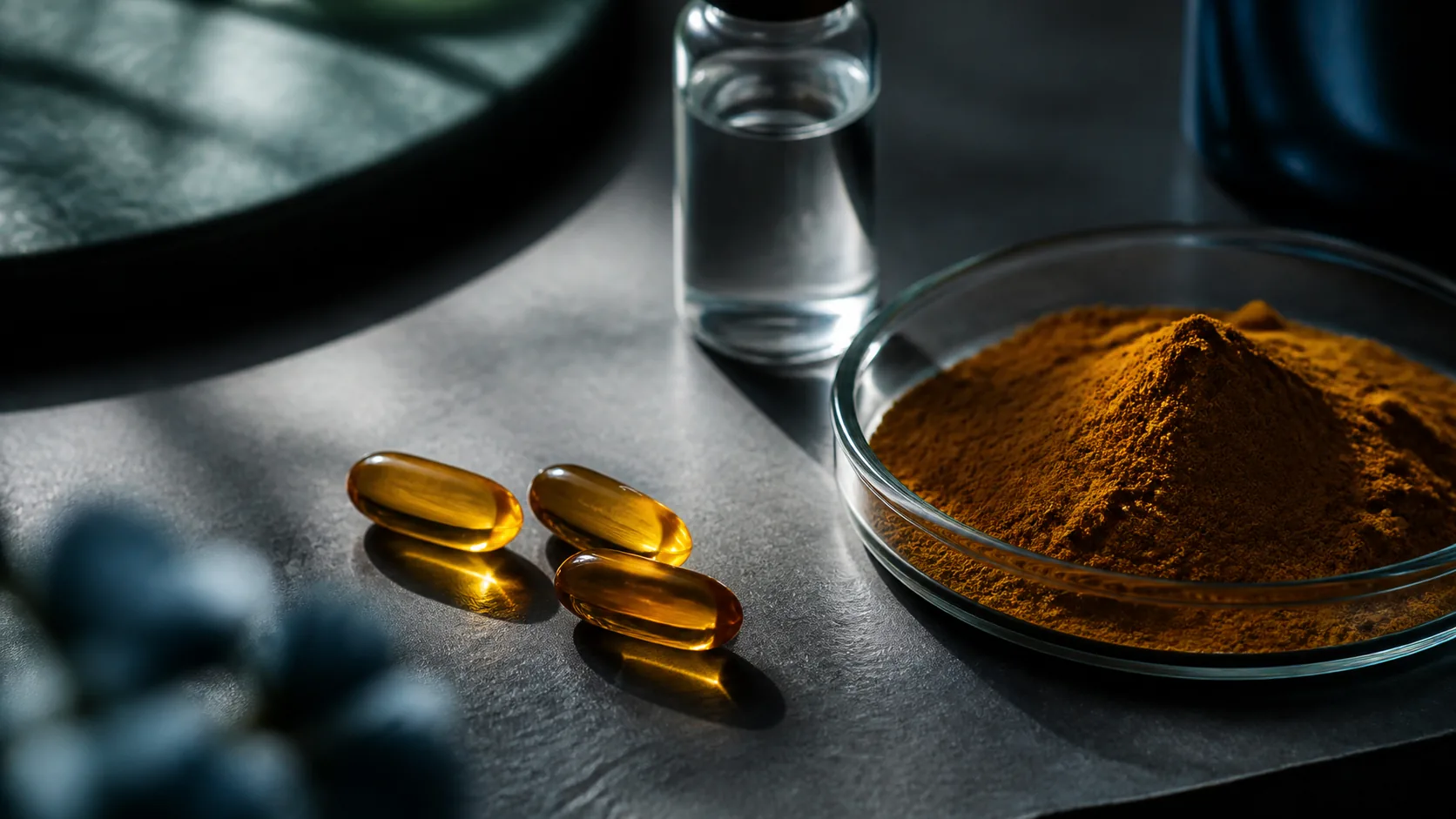
| How to take it | With a fatty meal | CoQ10 is fat-soluble, absorption is poor without fat |
Because CoQ10 is fat-soluble, taking it on an empty stomach is close to pointless, as absorption drops sharply. Ubiquinol is preferable for older adults and for people with impaired absorption, although it costs more. The effect is not immediate: tissue levels build gradually, over weeks.
Safety and interactions
CoQ10 has a very good safety profile. Even high doses are usually well tolerated and serious side effects are rare, with occasional mild gastrointestinal discomfort. The one practical caution is the interaction with anticoagulants, warfarin in particular: CoQ10 is structurally similar to vitamin K and could in theory weaken their effect, so anyone taking these drugs needs medical supervision.
Who coenzyme Q10 may help
All of this adds up to a clear picture of who CoQ10 can be justified for: people with heart failure (as an addition to therapy, agreed with a doctor), older adults, and people taking statins who report muscle pain, where restoring the CoQ10 that statins deplete sometimes helps, though the data are mixed.
For a young healthy person with no deficiency and no indication, taking CoQ10 daily “for longevity” is mostly a waste of money. As with other supplements, the sensible order is to build the foundation first (movement, food, sleep) and turn to CoQ10 for specific conditions rather than just in case. Whether that foundation is working shows up in the pace of your own aging rather than in any capsule, and Longevity — the science of aging more slowly sets out what actually sets that pace and how it is measured.
Verdict: how justified is taking coenzyme Q10
CoQ10 is a supplement with a real but narrow evidence base. It is strong where there is a deficiency or heart disease, and weak as a universal geroprotector.
| Criterion | Assessment |
|---|---|
| Animal data | Weak on lifespan extension |
| Human data | Good in heart failure and in older adults |
| Mechanism | Clear (mitochondria, antioxidant) |
| Safety | High (caution with warfarin) |
| Bottom line | Useful in specific niches, not a universal anti-aging agent |
The practical takeaway: treat CoQ10 as a tool for specific situations (the heart, statins, age) rather than a mandatory “longevity pill” for everyone. If you have an indication, pick the better-absorbed form, take it with a fatty meal and do not expect an instant result. If you do not, put the same money and attention into movement, food and sleep, which deliver incomparably more.
Does a healthy person need coenzyme Q10?
Usually not. The body makes its own supply, and in people without a deficiency or heart problems CoQ10 has shown no proven benefit for longevity.
Should you take CoQ10 together with statins?
Statins lower CoQ10 levels, and for muscle pain on statins the supplement sometimes helps, though the data are mixed. Make that decision with your doctor.
Ubiquinol or ubiquinone, which should you choose?
Ubiquinol is absorbed better, especially in older age, but costs more. Ubiquinone is cheaper and suits many people. Either way, take it with a fat-containing meal.
Is coenzyme Q10 safe?
Yes, it has a good safety profile even at high doses. The main caution is warfarin, because CoQ10 can affect how it works.
Sources (4)
Disclaimer. This article is for information only and does not replace medical advice. Talk to a qualified clinician before changing anything about your health.