Curcumin and Longevity: An Evidence Review
By Longevity Lab · Published: July 21, 2026
Based on peer-reviewed research — full source list at the end of this article. This is educational information, not medical advice.
- Curcumin is the active compound in turmeric, with a pronounced anti-inflammatory effect.
- It acts on inflammatory pathways, NF-κB among them, that are tied to age-related disease.
- In humans the clearest benefit shows up in joint pain and in some metabolic markers.
- The main problem is very low bioavailability, so specialized forms or piperine are needed.
- Life extension in humans is not proven. This is an anti-inflammatory, not an elixir.
Curcumin, the polyphenol that gives turmeric its yellow color, has one well-supported effect in humans: it lowers inflammation and reduces pain in osteoarthritis, in some meta-analyses comparably to standard painkillers but with better tolerability. No study shows that curcumin extends human lifespan, so the honest label is moderate anti-inflammatory rather than proven geroprotector. Turmeric has been used in cooking and traditional medicine for thousands of years, and curcumin, its main active compound, became a supplement star. There is a lot of enthusiasm around it and just as much exaggeration. Here is what curcumin can actually do, and where the line runs between the science and the marketing.
What curcumin is and how it works
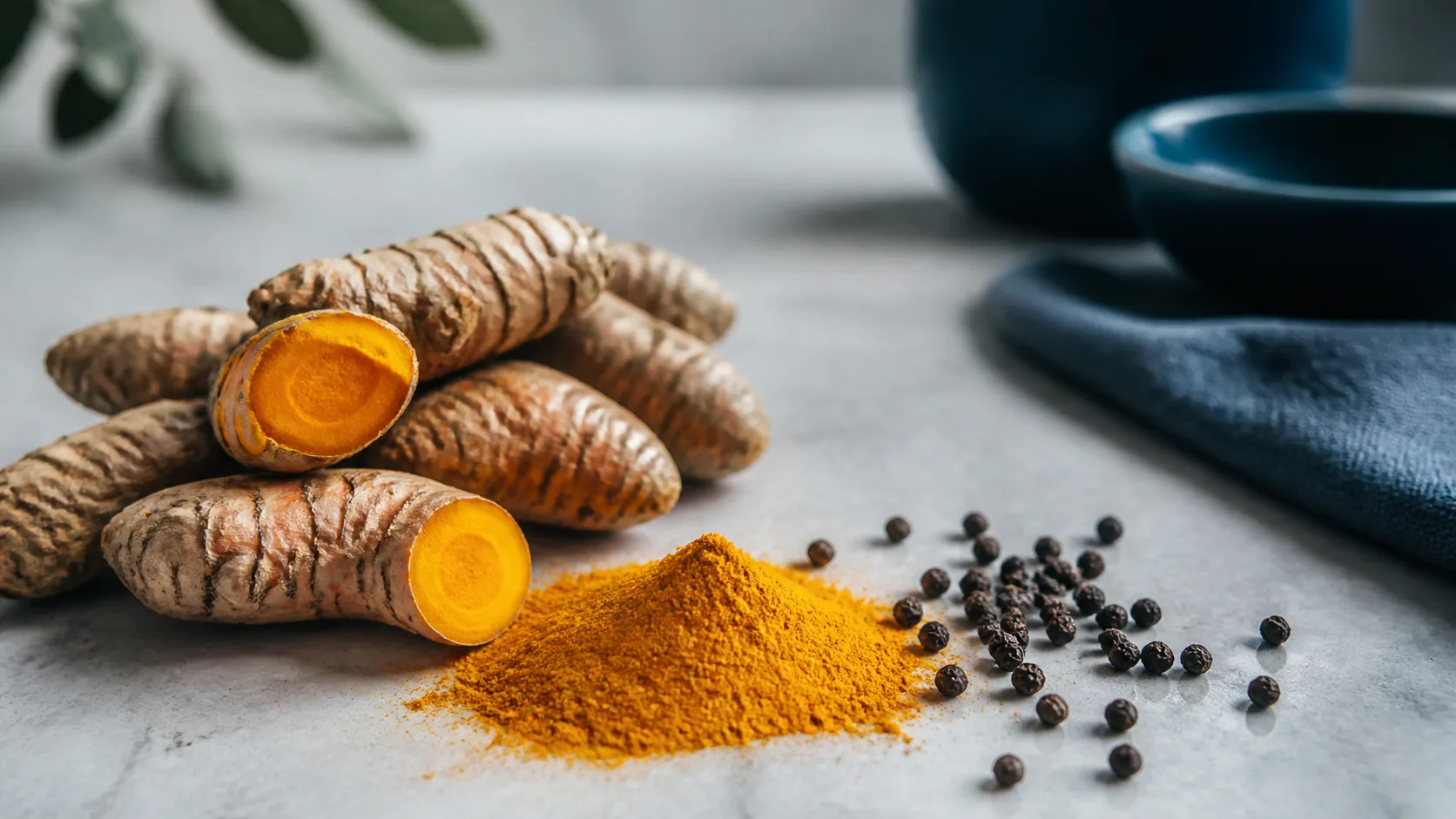
Curcumin is a polyphenol, and it is what makes turmeric bright yellow. Its defining property is anti-inflammatory and antioxidant action, meaning it works against inflammation and against Oxidative stress. At the molecular level curcumin acts on several inflammatory signaling pathways, and in particular it damps down nuclear factor kappa B (NF-κB), the master switch for inflammatory genes.
Chronic age-related inflammation is one of the key mechanisms of aging and the common denominator of many diseases, from atherosclerosis to osteoarthritis. A compound that can soften it therefore attracts the attention of longevity science, a field whose starting questions — why we age and what sets the pace — are laid out in Longevity — the science of aging more slowly. The only question is how much of that effect actually reaches people in practice.
What the research on curcumin shows
Animal and laboratory data
In test tubes and in model organisms curcumin shows a wide range of effects: anti-inflammatory, antioxidant, and action on cellular pathways linked to aging. In individual studies in flies and worms it even extended lifespan. Laboratory enthusiasm needs a filter, though. Curcumin is a well-known pan-assay interference compound (PAINS), one that produces a signal in a great many tests, and that does not always translate into real benefit in people.
Human data
In humans the most convincing data concern the anti-inflammatory and pain-relieving effect. Meta-analyses show that curcumin can reduce pain in osteoarthritis, sometimes comparably to standard painkillers but with better tolerability, which makes it an interesting addition when joints are the problem. There are also signals of improvement in individual metabolic markers and in Inflammatory markers. Those metabolic markers are ones you can follow yourself: an index such as METS-IR: metabolic score for insulin resistance reads insulin sensitivity off a routine glucose, triglyceride and HDL panel, which makes any change easier to judge than a subjective sense of feeling better.
There is no evidence that curcumin extends human life or prevents specific age-related diseases. Many of the studies are small and heterogeneous in the forms of curcumin they use. So the correct formulation is this: curcumin is a proven anti-inflammatory of moderate strength, not a confirmed geroprotector.
That heterogeneity is a reason for caution in its own right. Different studies used different curcumin forms, different doses and different tricks for raising absorption, which makes the results hard to compare directly. Part of the more impressive effects may have come from a good high-bioavailability formulation rather than from curcumin as such. One more reason not to carry loud laboratory headlines straight over to a jar of ordinary turmeric on the shelf.
It also helps to keep the wider context in view. We have plenty of anti-inflammatory tools, and most of them are lifestyle rather than supplements. Diet, movement, sleep and weight control lower inflammation systemically, with proven benefit for longevity. Because much of that inflammatory load tracks with visceral fat, a measure as simple as the Waist-to-height ratio (WtHR) tells you more about your own baseline than any supplement label does. In that picture curcumin is not the foundation but a possible addition for specific goals, and it should be judged on exactly those terms.
Bioavailability: the main problem with curcumin
The central difficulty with curcumin is that it absorbs extremely poorly. Ordinary turmeric powder is barely taken up at all, it is metabolized fast and cleared, so simply adding turmeric to your food is not enough for a therapeutic effect.
| Problem / solution | What it is | Notes |
|---|---|---|
| Low bioavailability | Poorly absorbed, cleared quickly | The main limit on the effect |
| Piperine (black pepper) | Raises absorption several-fold | The classic trick |
| Lipid and micellar forms | Specialized formulations | Absorbed better than plain powder |
| Taken with fatty food | Curcumin is fat-soluble | Improves absorption |
This is why supplements use high-bioavailability forms or a combination with piperine. Without that, even large doses of ordinary curcumin do little, an important detail that often gets missed.
Safety and interactions
Curcumin is broadly safe and well tolerated even at high doses, and side effects are usually limited to mild gastrointestinal discomfort. There are important caveats, though. Curcumin has a mild blood-thinning action and can amplify the effect of anticoagulants and antiplatelet drugs. It also stimulates bile flow, so it is contraindicated in bile duct obstruction, the classic cause of Cholestasis, and used with caution in gallstone disease. Piperine in the formulation can affect the metabolism of a number of medicines.
Verdict: how justified is taking curcumin
Curcumin is a real anti-inflammatory with an understood mechanism and good tolerability, carrying two large asterisks: weak bioavailability, and no evidence of life extension.
| Criterion | Assessment |
|---|---|
| Laboratory data | Broad, but needs careful interpretation |
| Human data | Moderate (joint pain, inflammation) |
| Mechanism | Understood (anti-inflammatory, NF-κB) |
| Bioavailability | Low, so specialized forms or piperine are needed |
| Bottom line | Useful as an anti-inflammatory, not a longevity elixir |
The practical takeaway: curcumin makes sense to consider for specific goals, joint pain for example, and only in an absorbable form. Do not expect rejuvenation from it. This is a supplement with a narrow but real benefit.
Culinary use deserves a separate note. Adding turmeric to your cooking is a pleasant and safe habit: the spice is rich in polyphenols, it brings flavor and color, and alongside black pepper and fat it raises curcumin absorption a little. Just do not confuse that gastronomic benefit with therapeutic doses. The proven effects on joints or inflammation require concentrated supplements in a bioavailable form, not a pinch of seasoning. Both roles of turmeric make sense. The point is to keep them apart, and not to transfer hopes from a concentrated supplement onto an ordinary spice, or the other way around.
Is eating turmeric in food enough?
For flavor and a small intake of polyphenols, yes, and it is a useful habit. But for a pronounced effect ordinary turmeric is barely absorbed; you need specialized forms or a combination with black pepper and fat.
Does curcumin help with joint pain?
Yes, this is one of the best-supported areas in humans: meta-analyses show reduced pain in osteoarthritis, sometimes comparable to standard painkillers but with better tolerability.
Does curcumin extend life?
In humans this is not proven. Lifespan extension has been recorded only in simple model organisms. In people, curcumin is an anti-inflammatory of moderate strength, not a confirmed geroprotector.
Who should not take curcumin?
Use caution if you take anticoagulants, have gallstone disease or bile duct obstruction, and before surgery. In those cases you need to talk to a doctor.
Sources (4)
Disclaimer. This article is for information only and does not replace medical advice. Talk to a qualified clinician before changing anything about your health.