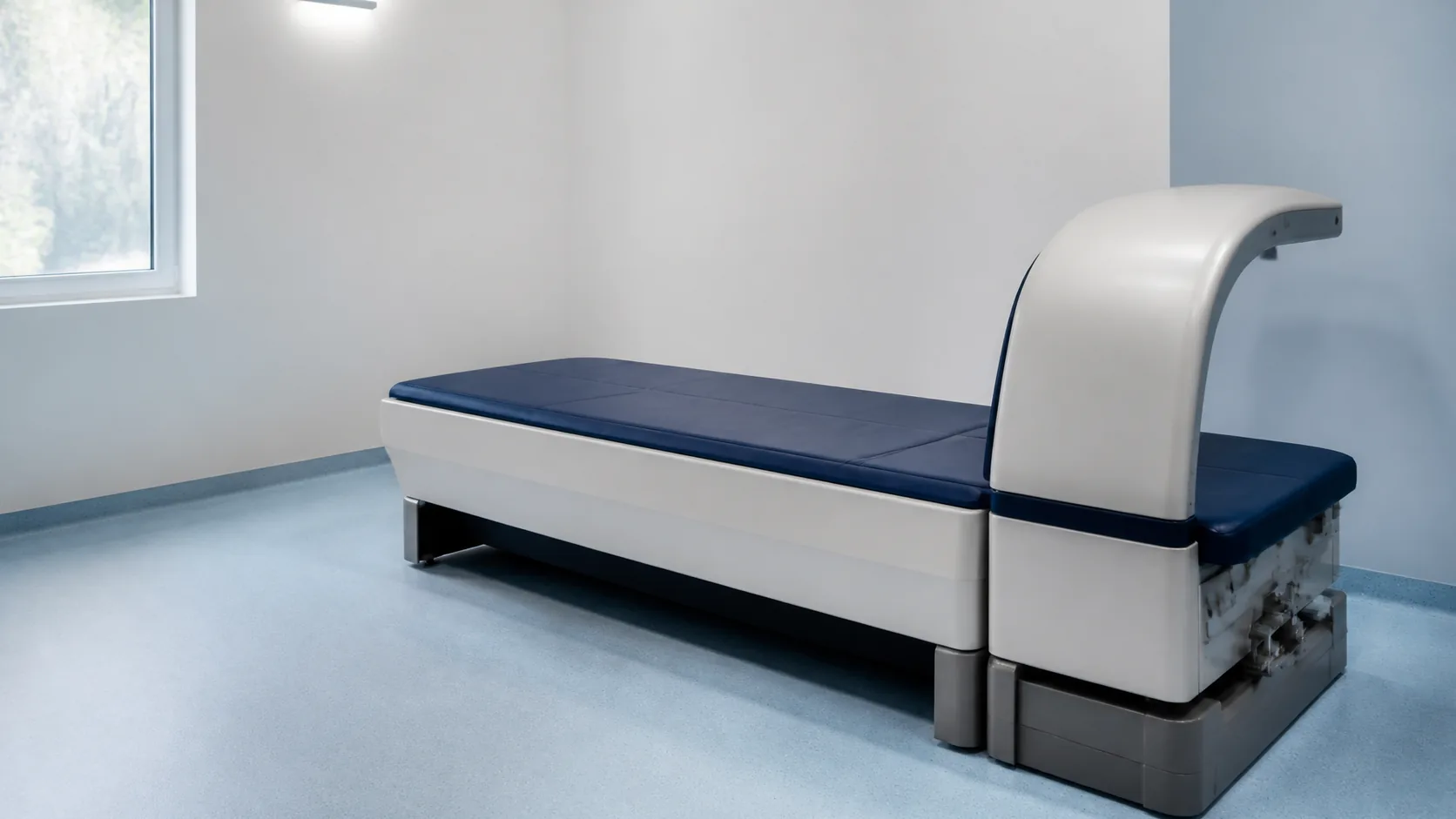
How to assess your body composition
Body composition is the split of your weight into fat mass and everything else — muscle, bone, organs and water — and a usable estimate needs only a tape measure and a scale, though the reference methods need a clinic. Two people of the same height and weight can carry very different amounts of muscle and fat, which is why the scale, and the BMI built from it, answers so little. At home you get an estimate from body measurements; the reference methods — DEXA, an air-displacement pod, hydrostatic weighing — sit in hospitals and sports clinics.
What you need
No blood draw, no appointment:
- Your age and sex — every equation is sex-specific and most adjust for age.
- Height without shoes, and weight from the same scale each morning before eating.
- Waist circumference, taped against bare skin at the end of a normal breath out, at the landmark your method names.
- Neck circumference, taken just below the larynx.
- Hip circumference at the widest point, which the female version of the circumference method needs.
- Optional: a bioimpedance scale reading, a skinfold caliper, or a DEXA report if you hold one.
How the measurement works
Everything hangs on one number: the share of your weight that is fat. Multiply weight by it for fat mass; subtract that, and the remainder is fat-free mass. Two routes reach it without equipment. Circumference equations, the US Navy method being the best known, weigh your waist against your neck and height, adding the hip in women: a bigger waist relative to those pushes the estimate up, greater height pushes it down. BMI-based equations, such as Deurenberg’s, use height, weight, age and sex instead, with estimated fat rising as BMI and age rise. Coefficients differ between published models and are left out on purpose; the directions do not.
The indices follow from those two masses. FFMI applies BMI’s arithmetic to lean tissue, dividing fat-free mass by height squared. Skeletal muscle mass comes from a separate anthropometric equation, and SMI expresses it relative to height squared or to body weight, as the sarcopenia literature does. Body composition assessment runs that chain from the measurements above, so you need none of the formulas; for the fat figure alone, with both routes side by side, Body fat assessment reports them together.
How to read the result
| What comes back | What it is saying |
|---|---|
| Body-fat percentage | The headline number, and the least precise one. |
| Fat mass | That percentage in kilograms: what a weight change is made of. |
| Fat-free mass | Muscle, bone, organs and water. Holding it steady while fat falls is the aim of sensible weight loss. |
| FFMI | Fat-free mass scaled to height, so it compares across people. |
| SMM and SMI | Estimated skeletal muscle, absolute and scaled — the pair that matters most with age. |
Treat any single verdict cautiously: the bands are not universal. Healthy ranges for body fat differ by sex, shift with age, vary between the organizations that publish them, and do not transfer across methods — a percentage from a bathroom scale and one from DEXA are different quantities. Essential fat, the physiological minimum, is substantially higher in women, so a single table for both sexes is always wrong. Read your value mainly against your own earlier readings, taken the same way.
What it does not tell you
Not where the fat sits. Two people at the same body-fat percentage can differ sharply in how much is visceral fat around the organs rather than under the skin, and the visceral share carries most of the metabolic risk. MRI and CT measure it, DEXA estimates it, tape methods catch it only indirectly; for distribution, Waist-to-height ratio (WtHR) answers a question composition cannot.
Not with laboratory precision, either. For one person a home estimate can be off by several percentage points either way — useful for tracking, weak as a one-off judgement. Bioimpedance readings move with hydration, a recent meal, alcohol, exercise and the time of day, so fix the conditions and repeat them. The equations also inherit their source populations — the circumference models came largely from military personnel, the BMI-based ones from mostly European adults — and both drift at the edges: the very lean, the very heavy, the highly muscular, and older adults who have traded muscle for fat at an unchanged weight.
And it is silent on much you might assume it covers. Bone density needs its own scan. Muscle is estimated as quantity, not quality or function, while sarcopenia definitions turn on strength and performance rather than mass. Nor is a flattering composition a clean bill of health: blood pressure, blood sugar, lipids and liver markers are unmoved by how good the number looks.
Related reading
Disclaimer. This article is for information only and does not replace medical advice. Talk to a qualified clinician before changing anything about your health.