How to screen for liver fibrosis with FIB-4
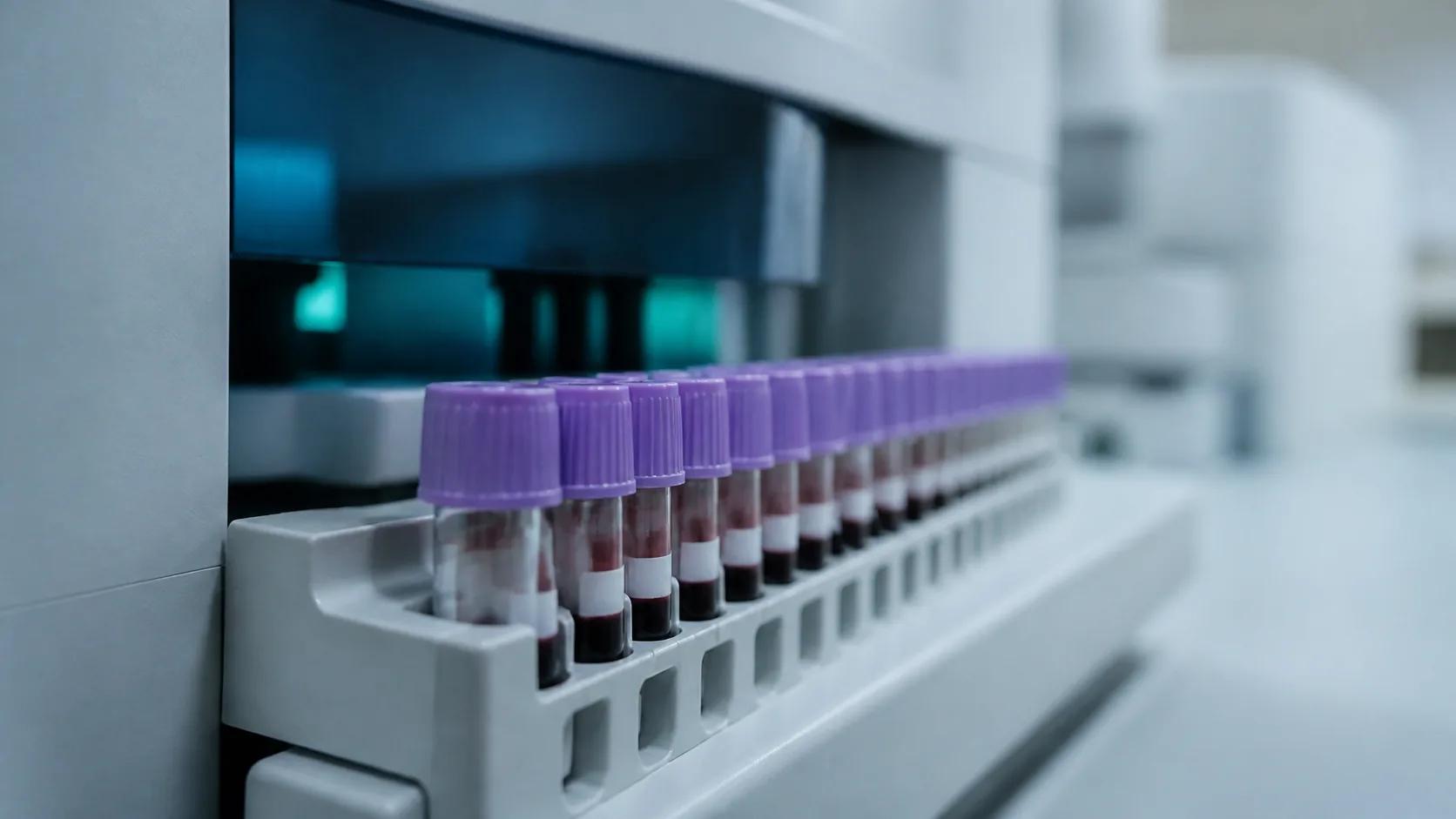
FIB-4 estimates how likely it is that you already have advanced scarring in the liver, from four numbers — your age, your AST, your ALT and your platelet count — so it takes one blood draw covering a routine liver panel and a complete blood count, and it is not a home measurement. No scan and no biopsy are needed to produce the score.
It is a triage test: it sorts people into advanced fibrosis unlikely, result unclear, or a specialist should look. Fibrosis is the stage that predicts serious outcomes, and it stays silent for years.
What you need
- Aspartate aminotransferase (AST), from a standard liver panel.
- Alanine aminotransferase (ALT), from the same panel.
- Platelet count, from a complete blood count, reported as 109/L in most of the world and as thousands per microliter in the United States; those are the same figure.
- Your age in years, an input to the score and not just context.
Neither panel requires fasting, and both are cheap and routinely ordered, so last year’s check-up may already hold the values. Use a draw taken when you were well: hard training, a drinking binge or an acute infection can move AST and ALT enough to change your band.
How the measurement works
Fibrosis is scar tissue replacing working liver, and the reference way to grade it is a biopsy. FIB-4 substitutes three traces scarring leaves in ordinary blood work. In early injury ALT usually runs higher than AST, and as fibrosis advances that balance tends to flip. The platelet count drifts down as a damaged liver makes less thrombopoietin and an enlarged spleen holds more back. And age counts on its own, since scarring accumulates over years.
Each input pushes in a known direction: higher age raises the score, higher AST raises it, and a lower platelet count raises it sharply. Higher ALT lowers it, but in a damped form, so a given proportional change in ALT moves the result less than the same change in AST or platelets. Hand arithmetic invites unit slips, so put the four values into the FIB-4 Fibrosis Index and let it place the result against the threshold that fits your age.
How to read the result
The output is a unitless number read against three bands — those used in the fatty liver disease pathway, where most readers meet it:
| FIB-4 score | What it usually means | Usual next step |
|---|---|---|
| Below 1.3 | Advanced fibrosis unlikely | No further liver testing now; repeat in a few years if risk factors persist |
| 1.3 to 2.67 | Indeterminate, the grey zone | A second test using different information |
| Above 2.67 | Advanced fibrosis possible | Assessment by a liver specialist |
Two caveats sit on top of that table. Age shifts the lower threshold: above roughly 65 a cut-off of 1.3 yields many false positives and guidelines commonly raise it to 2.0, while below about 35 the score performs poorly in both directions. The upper cut-off is not universal either: the original hepatitis C work used a higher one. A value just over a line is a prompt, not a verdict.
The grey zone is no small leftover: in unselected screening a sizeable minority land there, and the point is that they go on to a different test, usually elastography or another blood panel. The NFS fibrosis score is one of those, and because it adds body mass index, diabetes status and albumin, it does not simply repeat what FIB-4 saw.
What it does not tell you
FIB-4 diagnoses nothing and says nothing about cause: alcohol, metabolic fatty liver disease, hepatitis B and C, autoimmune disease and drug injury all raise it the same way. It is far stronger as a rule-out than a rule-in: a low score is good evidence against advanced fibrosis, a high one a reason to be assessed, not a finding of cirrhosis.
It does not measure liver fat: you can carry a great deal of steatosis with a low FIB-4, and the Fatty Liver Index (FLI) is built for that other question. Nor does a normal liver panel clear you: many people with advanced fibrosis have transaminases inside the reference range, which is why the platelet count is in the score.
Its inputs can mislead. Platelets fall for reasons unrelated to the liver — immune thrombocytopenia, chemotherapy, a spleen enlarged by something else — and rise with inflammation or iron deficiency. AST is not liver-specific: muscle injury, hard training and a hemolyzed sample all lift it. An acute hepatitis drives the number high with little chronic scarring, so a result taken during an illness should be repeated once you are well.
FIB-4 was derived in people with HIV and hepatitis C coinfection and validated far more widely since, but it is not established in children or pregnancy, and it tracks change over years, not weeks.
Related reading
Disclaimer. This article is for information only and does not replace medical advice. Talk to a qualified clinician before changing anything about your health.