Sarcopenic Obesity: Low Muscle, Normal BMI
By Longevity Lab · Published: August 23, 2026
Based on peer-reviewed research — full source list at the end of this article. This is educational information, not medical advice.
- Sarcopenic obesity is low muscle mass and function combined with excess fat, in the same person.
- Because the two changes offset on the scale, BMI can stay flat for decades while it develops.
- Outcomes are worse than for obesity or sarcopenia alone — the risks compound rather than average.
- ESPEN and EASO published diagnostic criteria in 2022: screen on function, confirm on composition.
- Resistance training plus adequate protein is the only intervention with consistent evidence.
Sarcopenic obesity is the coexistence of low muscle mass and strength with excess body fat, and it is the clearest example of BMI failing at exactly the moment it matters. Muscle is lost and fat is gained at roughly offsetting rates, so weight and the index hold steady for years while function declines underneath. In cohort studies the combination predicts disability, hospitalization and mortality more strongly than either obesity or Sarcopenia on its own.
Why the scale says nothing
From roughly the fourth decade, adults lose lean mass steadily while fat mass rises. In a typical trajectory the two changes are similar in magnitude, so total weight barely moves.
Consider a 45-year-old at 72 kg and 1.70 m — BMI 24.9. Thirty years later, at 73 kg, the BMI reads 25.6 once you account for a centimeter of height loss. Underneath, 8 kg of muscle has gone and 9 kg of fat has arrived. The index has moved by less than one point to describe a body that has changed completely.
No weight-for-height measurement can see this, because there is nothing in weight or height that carries the information. That is not a criticism of BMI so much as a statement of what it is.
Why the combination is worse than its parts
Excess fat and deficient muscle are not independent problems that happen to co-occur. They reinforce each other.
Adipose tissue, especially visceral, secretes inflammatory cytokines that promote muscle protein breakdown and interfere with anabolic signaling. Less muscle means less capacity to dispose of glucose, so insulin resistance rises, which promotes further fat storage. Less muscle also means less activity, which accelerates both.
The outcome data reflects that. Meta-analyses find higher all-cause mortality and substantially higher risk of physical disability in sarcopenic obesity than in either condition alone, with the excess apparent even after adjusting for the usual confounders.
How it is actually diagnosed
ESPEN and EASO published a consensus definition in 2022 with a two-stage structure worth understanding, because it tells you what to measure.
Screening comes first: a raised BMI or waist circumference alongside a marker of probable sarcopenia — a validated questionnaire, or simply being over 70. This stage is deliberately cheap.
Diagnosis requires two things confirmed. Altered skeletal muscle function, measured by grip strength or a chair-rise test, and altered body composition, meaning high fat mass with low muscle mass relative to body weight.
Note the order: function before composition. A scan showing low muscle mass in someone who is strong and mobile is a finding without a condition attached. The 2022 criteria put strength first for that reason, and it is the part you can check at home.
The home checks that matter
- Five chair rises. From a standard chair, arms folded across the chest, stand and sit five times. More than about 15 seconds suggests reduced lower-limb strength.
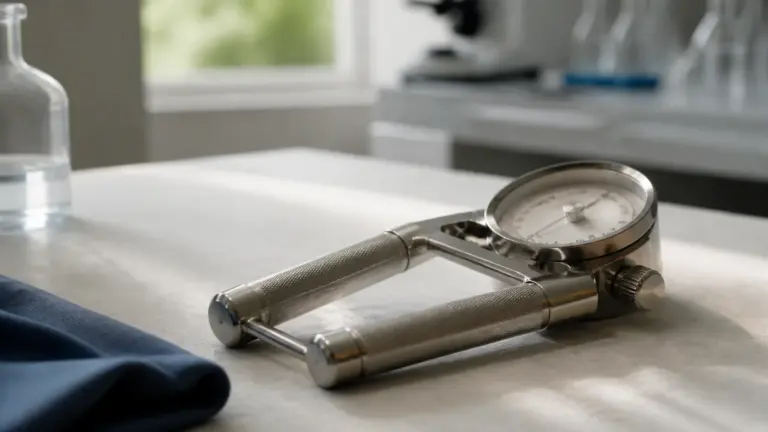
- Grip strength. A hand dynamometer costs little. Below roughly 27 kg in men and 16 kg in women is the EWGSOP2 cut-off for probable sarcopenia.
- Walking speed. Time yourself over 4 meters at usual pace. Below 0.8 m/s is a recognized marker.
- Waist and weight together. A rising waist with a static weight is the signature pattern.
Body composition assessment estimates the fat and lean split from measurements you can take with a tape, which is the closest cheap substitute for the scan the formal criteria call for. Fitness age: the age of your physical fitness scores endurance, strength, balance and composition side by side, which is a more useful summary than any single number when function is the thing at stake.
What actually reverses it
One intervention has consistent evidence: progressive resistance training. It increases muscle mass and strength at every age tested, including in adults over 85, and it is the only thing that reliably does. Two to three sessions a week, working the major movements, with load that increases over time.
Protein supports it. Older adults need more than the standard recommendation to achieve the same muscle protein synthesis — roughly 1.0–1.2 g per kilogram per day as a baseline, and 1.2–1.5 g when training or recovering from illness. Spreading it across meals matters more than the total in older adults, because each meal needs to clear a threshold to trigger synthesis at all.
Weight loss alone is the wrong intervention, and can make things worse: an unstructured deficit in an older adult takes Lean muscle mass preferentially. If weight loss is warranted, it must be paired with resistance training and a higher protein intake — otherwise you are treating the Body fat mass (FM) and accelerating the muscle problem at the same time.
Frequently asked questions
What is sarcopenic obesity?
The coexistence of low muscle mass and strength with excess body fat. Because the two offset on the scale, weight and BMI can stay unchanged while it develops.
How do I know if I have it?
Screen on function first: five chair rises over about 15 seconds, low grip strength, or slow walking speed, alongside a raised waist or BMI. Confirm with a body composition measurement.
Can BMI detect sarcopenic obesity?
No. It has no input for body composition, and the condition is defined by composition changing while total mass does not.
What is the treatment?
Progressive resistance training with adequate protein, roughly 1.2–1.5 g per kilogram per day for older adults. Weight loss without training makes the muscle side worse.
Sources
Sources (4)
- Donini LM, Busetto L, Bischoff SC, et al. Definition and diagnostic criteria for sarcopenic obesity: ESPEN and EASO consensus statement. Clin Nutr. 2022;41:990–1000. PubMed →
- Batsis JA, Villareal DT. Sarcopenic obesity in older adults: aetiology, epidemiology and treatment strategies. Nat Rev Endocrinol. 2018;14:513–537. PubMed →
- Cruz-Jentoft AJ, Bahat G, Bauer J, et al. Sarcopenia: revised European consensus on definition and diagnosis. Age Ageing. 2019;48:16–31. PubMed →
- Fiatarone MA, O’Neill EF, Ryan ND, et al. Exercise training and nutritional supplementation for physical frailty in very elderly people. N Engl J Med. 1994;330:1769–1775. PubMed →
Disclaimer. This article is for information only and does not replace medical advice. Talk to a qualified clinician before changing anything about your health.