How to measure vascular age with flow-mediated dilation
Flow-mediated dilation (FMD) measures how much an artery in your arm widens when blood surges back through it after five minutes of compression, and getting the number requires an ultrasound scan in a vascular lab — it is not a home measurement. That percentage reflects how well its inner lining still responds. Combined with your blood pressure, body composition, HbA1c and cholesterol, it becomes an age for your arteries.
FMD needs high-resolution ultrasound, a trained operator and a strict protocol, so it is done mainly in research units and a few specialist vascular clinics, rarely as routine care. Without a scan, a model built from ordinary measurements is the fallback.
What you need
- An appointment at a lab that performs brachial artery FMD, and its report: baseline and peak diameter, and %FMD.
- The lab’s preparation rules: usually a fast of several hours and no caffeine, alcohol, tobacco, fatty food, vitamin C or hard exercise beforehand.
- A recent blood pressure reading, systolic and diastolic, ideally averaged over several measurements rather than one clinic value.
- Body composition: height, weight and waist, plus body-fat percentage if measured.
- HbA1c, your average blood glucose over recent months.
- A standard lipid panel: total cholesterol, HDL, LDL and triglycerides.
- Your age and sex, which set the comparison.
How the measurement works
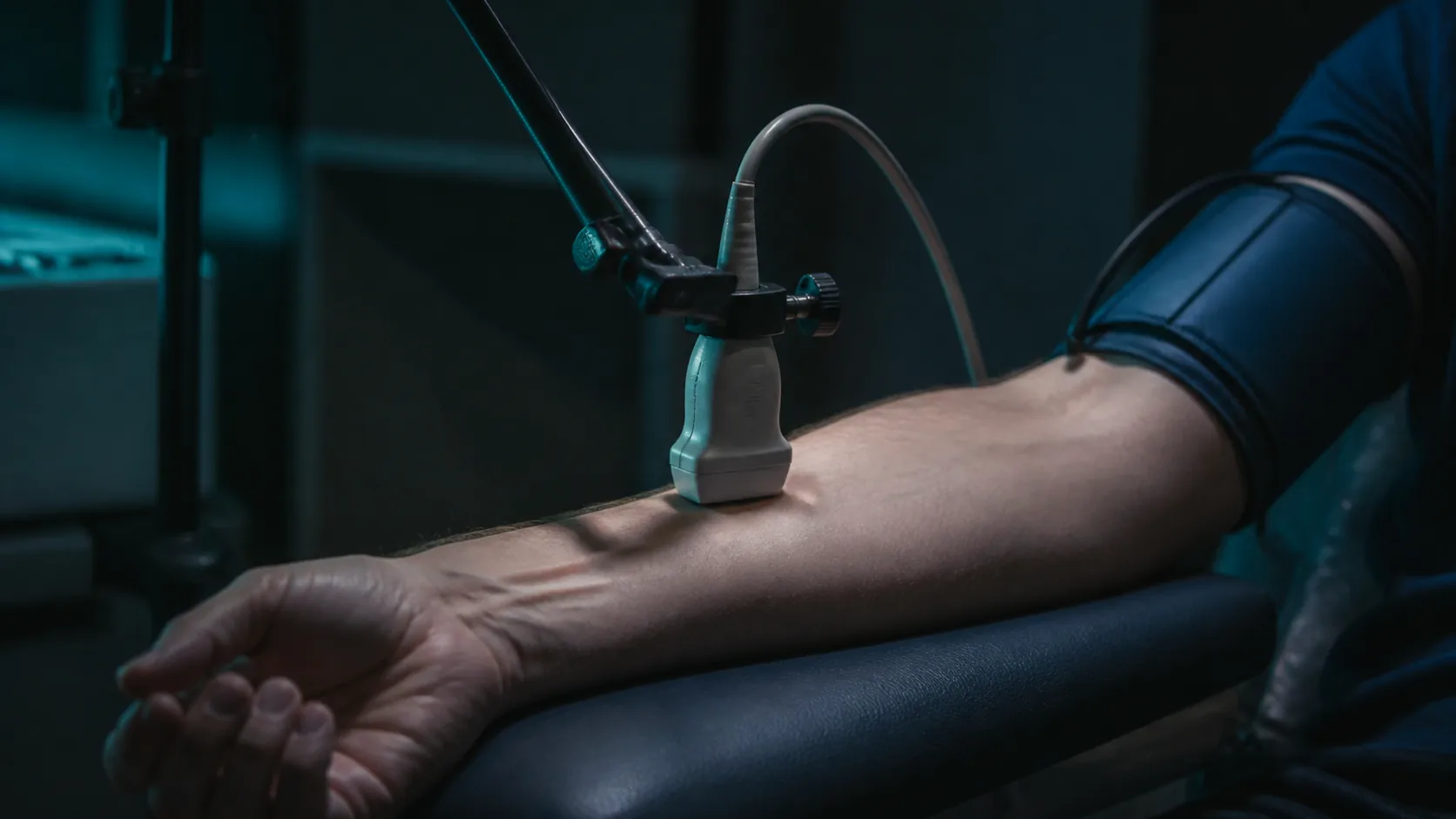
You lie still for ten to fifteen minutes in a quiet, temperature-controlled room. The operator holds an ultrasound probe over the brachial artery above the elbow and records its resting diameter. A forearm cuff is inflated well above your systolic pressure for five minutes, cutting off flow. On release, blood rushes back and drags along the vessel wall; a healthy lining answers with nitric oxide, the wall relaxes, and the artery widens, peaking within about a minute. Flow-mediated dilation (%FMD) is that peak diameter as a percentage increase over the resting one.
An artery that widens well still has a responsive lining; one that barely moves does not. The Vascular age calculator takes %FMD as its endothelial input, using the Everist VAC model, then adjusts for the pressure the arteries work against, the metabolic load they carry and the lipids moving through them, and shows what each contributed. Each input pushes in one direction:
| Input | What raises vascular age |
|---|---|
| %FMD | Less widening after the cuff |
| Blood pressure | Higher systolic and diastolic |
| Body composition | More fat mass, larger waist |
| HbA1c | Higher average glucose |
| Cholesterol | More atherogenic cholesterol, less HDL |
How to read the result
The output is an age in years, read against your actual age: higher means your measurements resemble those of older people, lower the opposite. Treat the gap as a summary, not a diagnosis.
No single %FMD threshold separates healthy from unhealthy. The direction is consistent, though: %FMD falls with age, falls earlier with hypertension, smoking, diabetes and obesity, and rises with training and treatment. Absolute values are not comparable between laboratories, because probe position, cuff placement, analysis software and baseline artery size all shift the number. A repeat scan in the same lab tells you more than one value against a published average. If a scan is out of reach, Vascular Age ADVANT’AGE estimates the same idea without one.
What it does not tell you
FMD tests function, not structure. It reads how the artery lining behaves today, not whether plaque is there: you can have a respectable %FMD and still carry atherosclerosis, which is what a coronary calcium scan or carotid ultrasound is for. It is also fragile: the change being read is a fraction of a millimeter, so operator skill and analysis method matter enormously, and poor reproducibility between centers is a long-standing criticism. A meal, coffee, a cold room, poor sleep or recent exercise can each move a single reading by enough to matter.
The composite inherits its inputs’ weaknesses: HbA1c is distorted by anemia and altered red cell turnover, and one blood pressure reading may reflect the clinic, not your arteries. Most FMD reference data come from research cohorts younger and healthier than the general population, and the technique predicts events better across groups than for individuals. A vascular age communicates risk factors; it does not measure biological age, name the cause of your number, or say what to do about it.
Related reading
- Vascular age
- Endothelium
- Heart Health: A Prevention Guide for Longevity
- What Biological Age Is and How to Measure It
Disclaimer. This article is for information only and does not replace medical advice. Talk to a qualified clinician before changing anything about your health.