How to estimate your heart age
Heart age reports the state of your cardiovascular system as an age: the age of a person whose heart looks like yours. Two routes lead there. One reads a resting 12-lead electrocardiogram with a trained artificial-intelligence model; the other runs your standard risk factors through an equation. The risk-factor version you can do at home. The ECG version you cannot: it needs a tracing recorded on clinic equipment, and a smartwatch strip is not the same input.
What you need
For the risk-factor route, collect this first:
- age, sex, and ethnic background if asked;
- smoking status, in the detail the tool requests;
- a recent systolic blood pressure, treated or not;
- total and HDL cholesterol from a lipid panel;
- height and weight;
- diabetes status and type;
- early heart disease in a parent or sibling;
- conditions newer equations ask about, such as chronic kidney disease or atrial fibrillation.
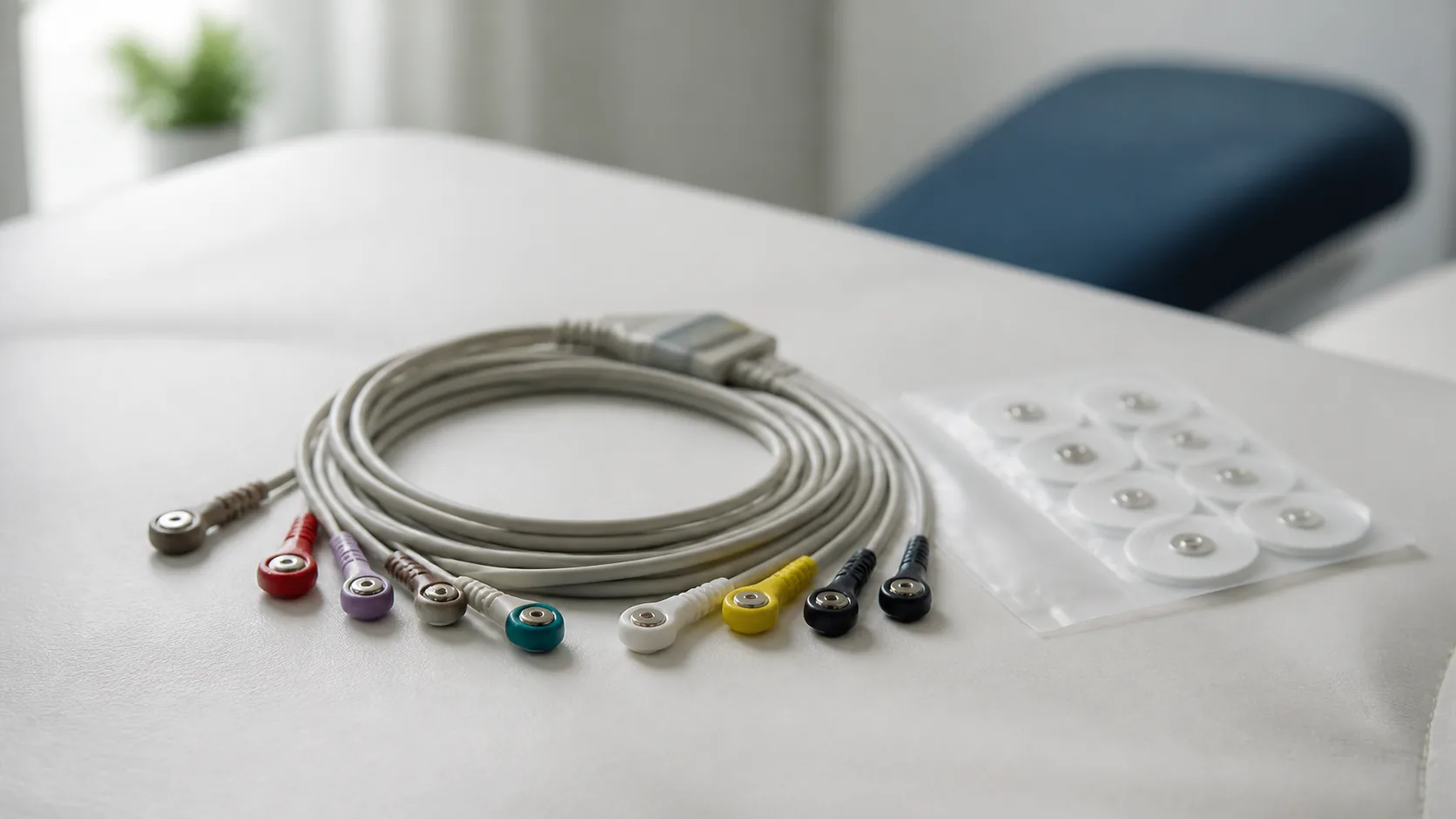
The ECG route needs an appointment: ten electrodes, a few minutes lying still, and the tracing goes to the model. A third route reads cardiac aging from an ultrasound of the heart, which needs a sonographer and a scanner, and is the basis of A cardiac ultrasound reveals your biological age.
How the measurement works
The risk-factor version first estimates your probability of a cardiovascular event over ten years, then asks at what age a person of your sex, with risk factors at the levels it treats as optimal, would carry that same probability. That age comes back as your heart age. Smoking, higher systolic pressure, a higher total-to-HDL cholesterol ratio, diabetes and a higher body mass index all raise it; correcting any of them lowers it. That is the logic behind Heart Age QRISK.
The ECG version works differently. A neural network is trained on large archives of 12-lead tracings, each labeled with the patient’s age at recording, and learns which waveform features move with age: small shifts in intervals, amplitudes and repolarization that no human reader turns into a number. Given your tracing it returns a predicted age, and the information sits in the gap between that and your real age. Nothing is adjustable at the moment of measurement, which makes the method hard to audit. That is the estimate produced by AI reveals your heart’s age.
How to read the result
Read the output as a gap. A heart age near your calendar age means you resemble the average person of your years; above it, someone older; below it, someone younger. No agreed cut-off marks where that gap turns clinically meaningful, and it differs between tools, so a page handing you a precise threshold has invented it.
What the evidence supports is a direction. In cohort studies, people whose ECG-predicted age runs several years above their chronological age go on to have more cardiovascular events and higher mortality, and the effect grows with the gap, though its size varies by cohort and model. The risk-factor heart age is frankly a communication device, built because years land harder than a percentage. Use it as an argument for acting on the modifiable inputs.
What it does not tell you
Heart age is not a diagnosis. Neither route looks for a narrowed artery, nor replaces a coronary calcium score, a stress test or an echocardiogram when symptoms call for one. Nor does it say when: a ten-year risk rendered as years is not a countdown.
The risk-factor version inherits the limits of the equation beneath it. Those equations were fitted to particular populations, QRISK to United Kingdom primary care records and Framingham to a largely white American cohort, and can be miscalibrated outside them. The comparison is also stacked: you are measured against a reference person with optimal risk factors, so most users of public heart age tools are told theirs exceeds their real age.
The ECG version is model-specific. Two networks trained on different archives can return ages years apart on the same tracing, so results do not transfer between services. The tracing shifts with heart rate, electrolytes, medication and lead placement, so one recording is noisier than a confident number suggests, and in most health systems this is still a research instrument. Neither route sees what its inputs omit, from lipoprotein(a) to inflammatory markers.
Related reading
- Heart Health: A Prevention Guide for Longevity
- What Biological Age Is and How to Measure It
- Vascular age
- ASCVD
Disclaimer. This article is for information only and does not replace medical advice. Talk to a qualified clinician before changing anything about your health.