What to Do After You Calculate Your BMI
By Longevity Lab · Published: August 23, 2026
Based on peer-reviewed research — full source list at the end of this article. This is educational information, not medical advice.
- BMI is a screening step. On its own it justifies no decision.
- Four cheap measurements turn it into something usable: waist, blood pressure, a fasting panel and a strength test.
- A raised BMI with a normal waist and clean bloods usually needs nothing.
- A normal BMI with a raised waist is the case most often missed, and it needs the full workup.
- Where change is warranted, target 5–10% of body weight — not a BMI category.
A BMI result is the beginning of an assessment, not the end of one. On its own it justifies no decision, because it cannot distinguish muscle from fat or say where the fat sits. Four measurements — waist, blood pressure, a fasting blood panel and a simple strength test — cost almost nothing and convert the index into something you can actually act on. This is the checklist, and what each combination of results should make you do.
Step 1: take your waist
This is the single highest-value thing you can do next, and it takes twenty seconds. Measure midway between the lowest rib and the top of the hip bone, horizontal, at the end of a normal breath out, tape snug but not compressing.
Then divide by your height. Under 0.5 is the target. That ratio tells you whether a raised index is muscle or abdominal fat, and whether a normal index is hiding the latter — the two questions BMI cannot answer.
Raw Waist circumference thresholds work too: above 94 cm in men or 80 cm in women signals raised risk, above 102 cm and 88 cm substantially raised. Waist-to-height ratio (WtHR) scores the ratio against age-adjusted thresholds, which matters because a flat 0.5 over-flags adults past 50.
Step 2: the three cheap clinical numbers
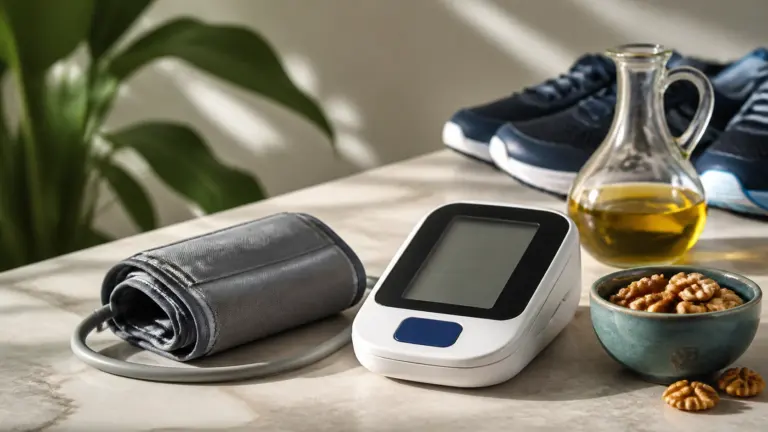
- Blood pressure. Seated, five minutes’ rest, correct cuff size, two readings averaged. It responds to weight change within weeks, so it is also the fastest feedback you will get.
- Fasting glucose and HbA1c. Prediabetes is silent and it is where intervention has the strongest evidence. A raised BMI is a reason to test, not a substitute for testing.
- Triglycerides and HDL. The lipid signature of insulin resistance — high triglycerides with low HDL — appears before anything else moves.
Together with waist, those four are the Metabolic syndrome criteria almost exactly. Three or more of the five is a diagnosis, and it is entirely possible to meet it at a BMI of 26 and to miss it at 32. That asymmetry is the whole reason this checklist exists.
Step 3: measure what your body can do
Function predicts outcomes that body size does not. Three tests, no equipment beyond a chair and a stopwatch:
- Five chair rises, arms folded. Over about 15 seconds suggests reduced lower-limb strength.
- Usual walking speed over 4 meters. Below 0.8 m/s is a recognized marker.
- Grip strength, if you have a dynamometer. Below roughly 27 kg in men and 16 kg in women flags probable sarcopenia.
In older adults these matter more than the index does. A BMI of 28 with good function is a better position than 23 with poor function, and the data on later independence is unambiguous about which one to worry about.
Reading the combinations
| BMI | Waist ratio | What it means | What to do |
|---|---|---|---|
| Normal | Under 0.5 | Reassuring | Nothing. Recheck annually. |
| Raised | Under 0.5 | Likely muscle | Confirm with bloods; usually no action |
| Normal | Over 0.5 | The commonly missed case | Full panel; train and build muscle |
| Raised | Over 0.5 | Unambiguous | Full panel; target 5–10% weight loss |
| Under 18.5 | Any | Investigate, especially if recent | See a clinician; check for unintentional loss |
The third row is the one this whole cluster keeps returning to. A normal index with a large waist is common, carries a genuine metabolic risk profile, and is the pattern that BMI-only screening is structurally incapable of finding.
If change is warranted, what to aim at
Not a BMI category. Clinical guidelines target 5–10% of current body weight, because that is the amount with demonstrated effects on blood pressure, glucose, triglycerides and liver fat — and because it is maintainable in a way that a return to a category usually is not.
Three things determine whether that loss does what you want. Resistance training two to three times a week decides how much of it comes from fat rather than muscle. Protein at 1.2–1.6 g per kilogram supports the same thing. And a deficit of 300–500 kcal a day, not more, is what most people can actually sustain past month three.
Track the waist alongside the weight. Visceral fat falls early in a deficit, so the tape often moves before the scale does — and if you are training, the scale may not move at all while everything underneath improves.
Where to go from here
Start with the number if you have not taken it: our BMI calculator gives the index, the category, your healthy weight range in kilograms and BMI Prime, and it takes an optional waist measurement so you get both halves of the reading at once.
Then go deeper where the result points. Body Mass Index (BMI) reports the same index alongside a Smart BMI score and a mortality-risk ratio, which is a more honest framing than a category name. And if you would rather see how the whole set of measurements combines rather than reading them one at a time, Individual Risk Assessment collects the individual risk scores in one place — the liver, metabolic, kidney and body-composition indices that a raised waist or a raised index is really a prompt to check.
The point of all of it is the same. BMI is a fast, free, imperfect screen that tells you whether to look further. Looking further is the part that changes anything.
Frequently asked questions
What should I do if my BMI is high?
Take your waist first. A raised BMI with a waist under half your height is usually muscle. If the waist is also raised, get blood pressure, fasting glucose, HbA1c and a lipid panel.
What if my BMI is normal but I do not feel healthy?
Measure your waist. A normal BMI with a waist above half your height is the most commonly missed pattern, and it carries much of the metabolic risk of obesity.
How much weight should I aim to lose?
5–10% of current body weight. That is the amount with demonstrated effects on blood pressure, glucose and liver fat, and it is far more sustainable than targeting a BMI category.
How often should I recheck my BMI?
Annually is enough for the index. Waist monthly and weight daily-with-a-weekly-average are the measurements worth taking more often.
Sources
Sources (4)
- Ross R, Neeland IJ, Yamashita S, et al. Waist circumference as a vital sign in clinical practice: a consensus statement from the IAS and ICCR working group. Nat Rev Endocrinol. 2020;16:177–189. PubMed →
- Wing RR, Lang W, Wadden TA, et al. Benefits of modest weight loss in improving cardiovascular risk factors in overweight and obese individuals with type 2 diabetes. Diabetes Care. 2011;34:1481–1486. PubMed →
- Alberti KG, Eckel RH, Grundy SM, et al. Harmonizing the metabolic syndrome. Circulation. 2009;120:1640–1645. PubMed →
- Rubino F, Cummings DE, Eckel RH, et al. Definition and diagnostic criteria of clinical obesity. Lancet Diabetes Endocrinol. 2025;13:221–262. PubMed →
Disclaimer. This article is for information only and does not replace medical advice. Talk to a qualified clinician before changing anything about your health.