How to estimate physical form age from VO2max
Physical form age converts an estimate of your VO₂max — the highest rate at which your body can take in and use oxygen — into an age in years, and the home version needs only your age, sex, a carefully taken resting heart rate and an honest account of how much you train. Aerobic capacity falls with age, so if your estimate matches the average for a 45-year-old, your physical form is 45 whatever your birth date says.
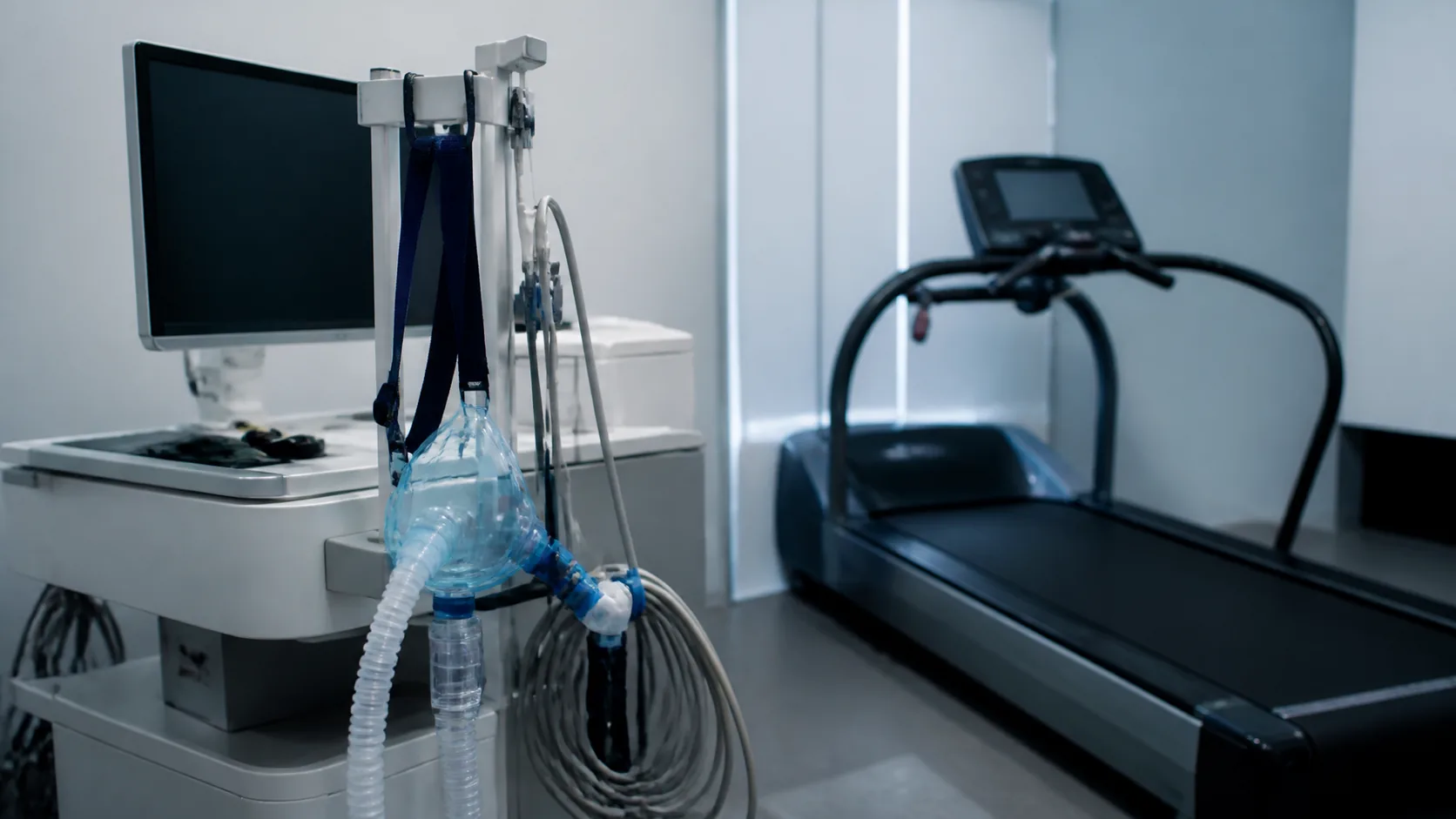
A true VO₂max is measured in a laboratory, riding to exhaustion in a mask that collects every breath; a questionnaire only estimates it.
What you need
Five minutes and something to count your pulse. No blood test, no treadmill, no clinic appointment.
- Age and sex — they set the reference curve you are judged against.
- Resting heart rate — 60 seconds lying still before you get up, or a wearable’s overnight low, averaged over three or four mornings.
- Your usual training — sessions per week, how long, and how hard: conversational, breathing hard but able to talk, or flat out. Describe the last few months, not your best.
- Height and weight — not every version asks, but VO₂max is reported per kilogram.
If you are unsure what counts as normal, Resting heart rate covers the range.
How the measurement works
Non-exercise estimates rest on one relationship: a heart that moves more blood per beat needs fewer beats at rest, so a low resting rate relative to your maximum implies a high aerobic ceiling. One published method simply scales that ratio by a fixed constant; others, such as Jackson’s non-exercise equations and the HUNT model, add self-reported activity, body size and sex. Few people have measured their own peak pulse, so it is predicted from age — 220 minus age, or the better-calibrated Tanaka equation.
The direction each input pushes is clear even where the coefficients are not: a lower resting heart rate raises the estimate, harder training raises it, greater age lowers it, and more body weight lowers a per-kilogram value. Coefficients differ between models, so hand the arithmetic over. Physical form age: your VO₂max returns the estimated VO₂max, the matching form age, your maximum heart rate and reserve, and five training zones.
How to read the result
| What you get | How to read it |
|---|---|
| Estimated VO₂max | Milliliters of oxygen per kilogram per minute; readable only against age- and sex-specific references. |
| Physical form age | The age at which your estimated VO₂max would be average. Below your real age is better than typical. |
| Maximum heart rate and reserve | Your age-predicted ceiling, and the range between resting and maximum pulse. |
| Five heart rate zones | Roughly 50 to 100 percent of maximum heart rate, for dosing sessions, not judging fitness. |
Read the gap, not the digits. Reference bands are age- and sex-specific and differ between registries, so no single "good" figure is worth quoting here. A form age below your own says your capacity resembles that of younger people in the reference set, not that you are younger. A year either way sits inside the noise of a night-to-night pulse; trust a change only if it survives two or three months of training.
What it does not tell you
This is not a measured VO₂max. Non-exercise models are fitted on group averages: fair at ranking a population, blunt on any one person. Track yourself with it if you like, but one value is not your true capacity: that takes a cardiopulmonary exercise test.
The inputs bring their own problems. Resting heart rate rises with poor sleep, alcohol, caffeine, fever, stress and anemia, and falls on beta blockers, which break the ratio the model depends on and make the result meaningless. Self-reported training is the input people flatter most. And because the value is per kilogram, losing weight raises it arithmetically, with no change in heart or lung function.
Aerobic capacity is only one axis: it says nothing about strength, bone density, balance, blood pressure or glucose. A wider view needs a multi-component score such as Fitness age: the age of your physical fitness plus real blood work. A flattering form age does not clear you of heart or lung disease: breathlessness or chest tightness on exertion is a reason to see a clinician, not to rerun a calculator.
Related reading
- VO2 Max: Why Aerobic Fitness Predicts Longevity
- How to Build a Training Program for Longevity
- VO2max
- Cardiorespiratory fitness
Disclaimer. This article is for information only and does not replace medical advice. Talk to a qualified clinician before changing anything about your health.